
Sweepstakes Slot Machines in the US: The Complete Data-Driven Guide 2026
 Available in GB
Data-first analysis of the .6B sweepstakes slot market — growth, regulation, fairness, and who actually plays.
Start Reading
Feature Buy vs Organic
Sweepstakes slot machines are the largest unregulated segment of the American gambling economy, and almost nobody writing about them is working with real numbers. In 2024, the US sweepstakes casino market generated .6 billion in gross revenue and .4 billion in net revenue, according to data compiled by KPMG from Eilers & Krejcik Gaming's Social Sweepstakes Gaming Monitor. That figure sits entirely outside the official US gambling statistics.
This is a data-first analysis. Not a list of casino brands with referral links. Not a promotional roundup dressed up as journalism. What follows is a systematic breakdown of how sweepstakes slots work, who plays them, who regulates them (spoiler: almost nobody), and what the numbers actually say about an industry that grew at a 60-70% compound annual rate for four consecutive years before slamming into a wall of state bans, cease-and-desist orders, and class-action lawsuits.
Six states banned sweepstakes casinos in 2025. Eilers & Krejcik have revised their 2026 forecast downward by 10%. More than 100 class-action suits are working through courts. And yet, in the 40-plus states where these platforms still operate, sweepstakes slots remain freely accessible to anyone with a browser and an email address. The gap between the scale of the market and the depth of public information about it is staggering. This guide exists to close that gap.
What .6 Billion in Unregulated Slots Means for US Players
- The US sweepstakes casino market hit .6B gross revenue in 2024, growing at a 60-70% CAGR since 2020 — all outside official gambling statistics.
- Six states banned sweepstakes casinos in 2025, and Eilers & Krejcik project a 10% revenue decline in 2026 as regulatory pressure escalates.
- Sweepstakes platforms are not required to publish RTP data or pass independent RNG audits, leaving players without the fairness guarantees standard in licensed iGaming.
- A Lancet meta-analysis found 15.8% problem gambling rates among online slot players — the highest of any gambling format — while sweepstakes casinos lack standardized responsible gaming tools.
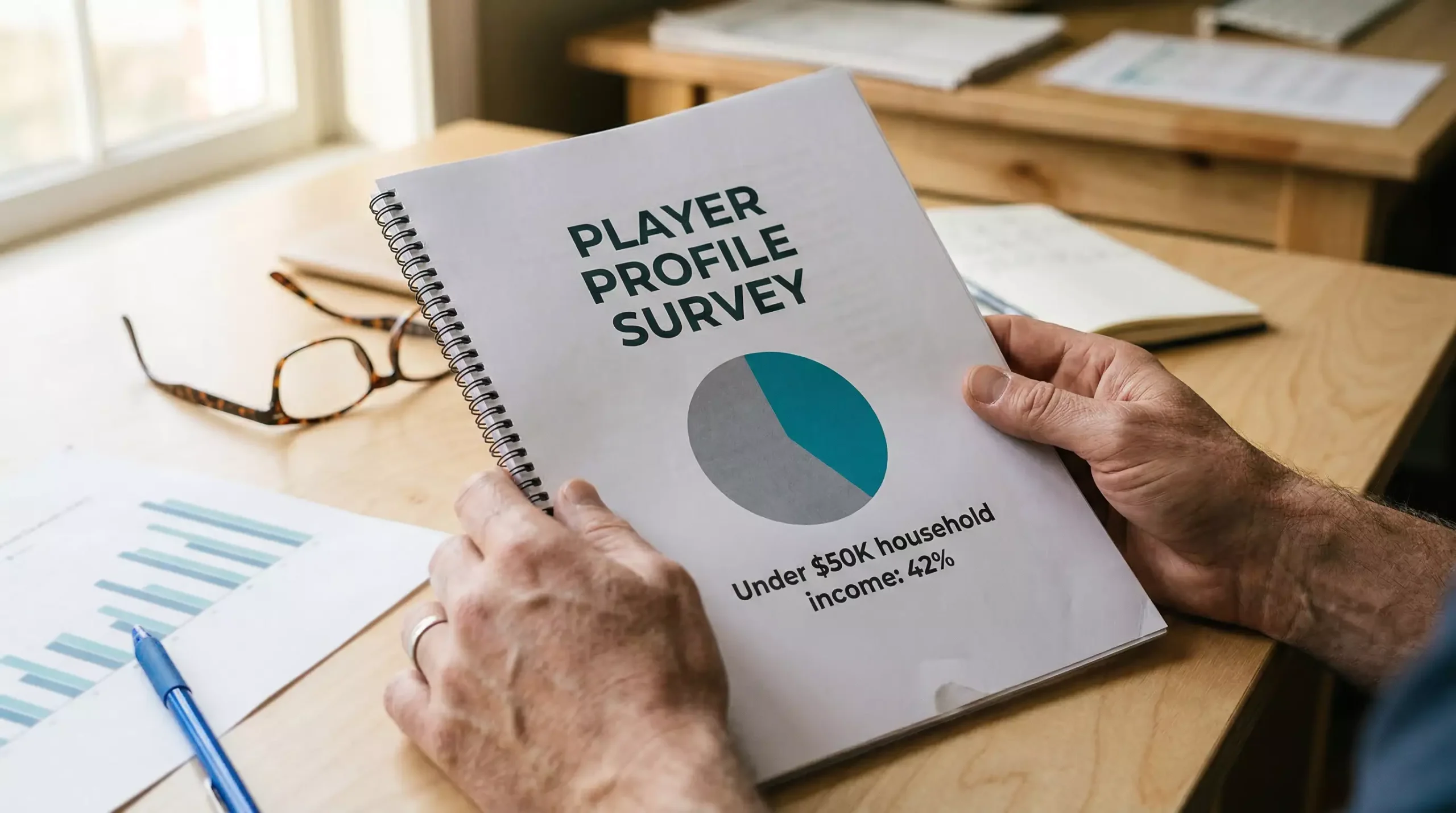
- Only 12% of users ever purchase coins, but this whale-driven model generates billions; 42% of players earn under ,000 annually.
The Sweepstakes Slot Market: Size, Growth, and Scale
The numbers tell a story that most industry coverage has missed entirely. In 2024, US sweepstakes casinos generated .6 billion in gross revenue — player purchases of virtual currency — and .4 billion in net revenue after prize payouts. To put that in perspective, the entire regulated US iGaming market across seven licensed states brought in .2 billion over a comparable period. A single industry segment that most Americans have never heard of is generating more money than the combined legal online casino operations of New Jersey, Pennsylvania, Michigan, Connecticut, West Virginia, Delaware, and Rhode Island.
The growth trajectory behind those numbers is equally striking. KPMG's 2025 gaming industry primer reports a compound annual growth rate of 60-70% between 2020 and 2024 for sweepstakes casino revenue. In 2023 alone, the market grew 61%, reaching .6 billion in player purchases and billion in net revenue, with a trailing five-year CAGR of 85% from 2019. No other segment of the American gambling industry — not sports betting, not daily fantasy, not traditional casino gaming — has sustained anything close to that pace.
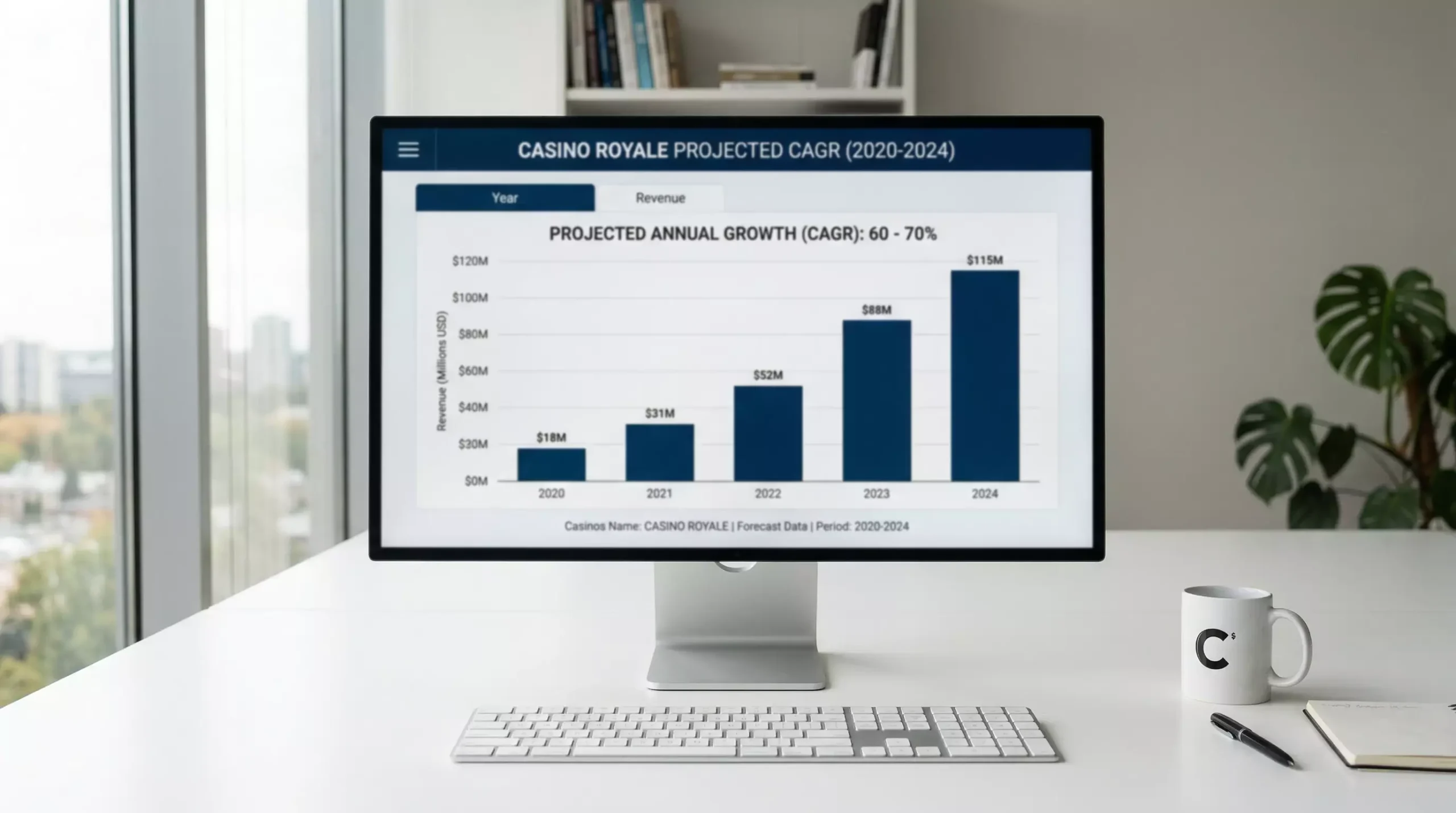
An estimated 98% of all global sweepstakes casino revenue comes from the United States. This is, for all practical purposes, an exclusively American phenomenon.
The supply side has expanded just as rapidly. According to RG.org's market analysis, between 150 and 190 active sweepstakes brands were operating in the US as of late 2025, with more than 25 new platforms launching during the year alone. The market is not just large — it is crowded, fragmented, and growing in ways that have caught regulators off guard.
What makes these figures particularly significant is their invisibility. Total US gambling expenditure reached 2 billion in 2024, a figure reported by Eilers & Krejcik Gaming. That number does not include sweepstakes casinos. They exist in a statistical blind spot — too large to ignore, too ambiguously classified to count. When analysts discuss the American gambling market, they are discussing a market that systematically excludes its fastest-growing and most controversial component.
The initial KPMG forecast projected gross revenue surpassing .3 billion and net revenue exceeding .6 billion by the end of 2025. Whether those projections hold depends on how the regulatory environment develops — a topic we will return to in detail. But even if growth decelerates sharply, the base that has already been established represents a market larger than many entire national gambling industries.
How Sweepstakes Slot Machines Actually Work
The legal architecture of sweepstakes casinos rests on a single structural argument: they are not gambling. Under US law, gambling traditionally requires three elements — prize, chance, and consideration (payment). Sweepstakes platforms claim to eliminate the consideration element by offering a free method of entry alongside paid options. You are not buying a chance to win, the argument goes. You are purchasing virtual Gold Coins as entertainment, and Sweeps Coins are simply a promotional bonus.
It is an elegant legal fiction, and 90% of the people actually using these platforms do not buy it. According to a 2025 survey by the American Gaming Association, 59% of sweepstakes casino players say their activity is "definitely gambling," and another 31% say it "probably" qualifies. The industry's legal framework and its users' lived experience exist in two different realities.
The Social Gaming Leadership Alliance, the trade group representing sweepstakes operators, maintains a different position. In response to New York's 2025 enforcement actions, SGLA stated that its partners "utilize established sweepstakes promotional frameworks which are distinct from gambling" and "always provide genuinely free participation methods through Alternative Methods of Entry." This is the core of the industry's defense: the model is promotional, the free entry is real, and therefore the Prize-Chance-Consideration test is not met.
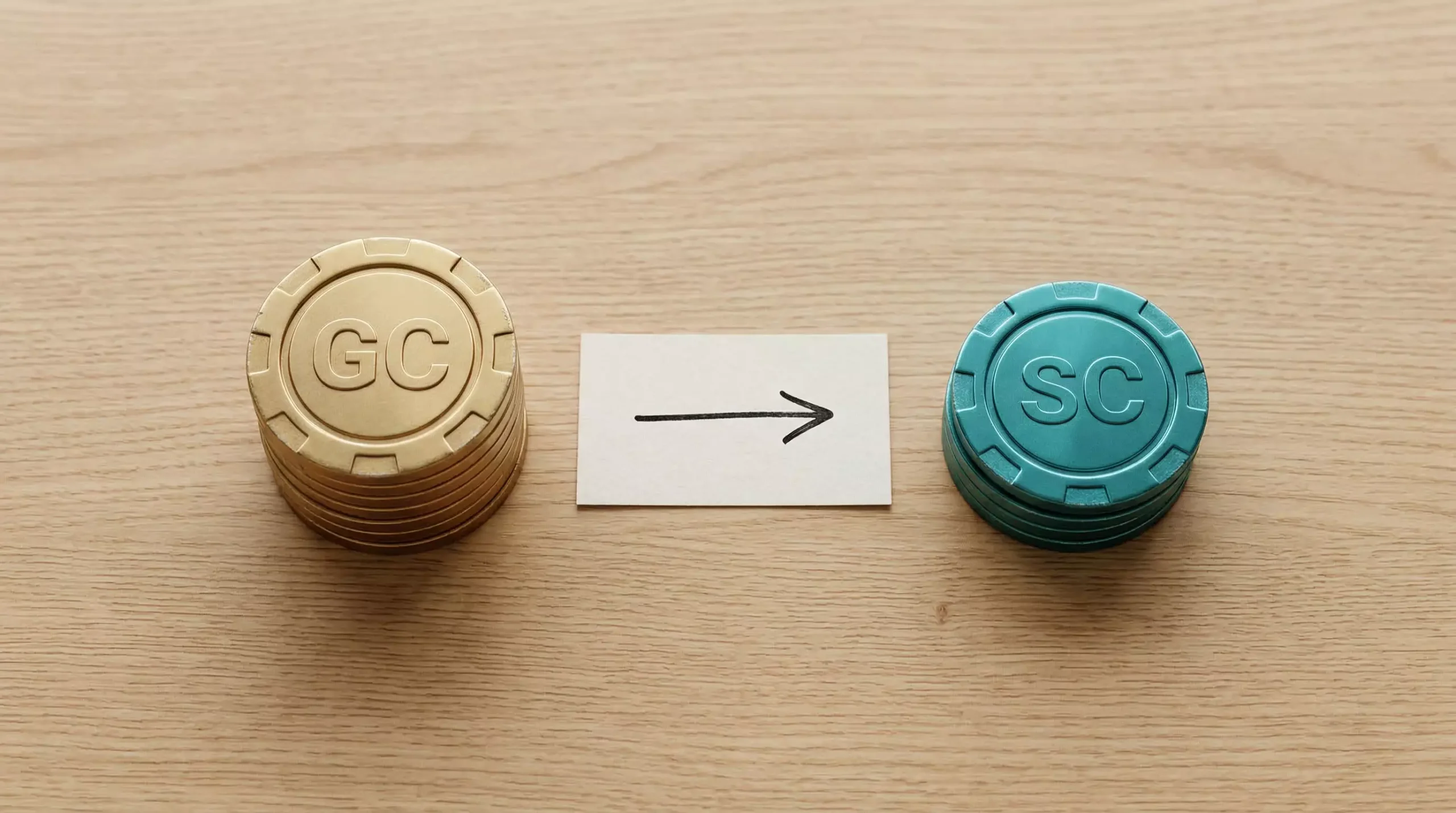
Alternative Method of Entry (AMOE) — Every sweepstakes casino is required to offer a free way to obtain Sweeps Coins without purchasing Gold Coins. Common methods include mailing a handwritten request to the operator's physical address, participating in social media contests, or claiming daily login bonuses. In practice, the overwhelming majority of Sweeps Coins in circulation are obtained through Gold Coin purchases.
The practical mechanics reinforce this disconnect. Players sign up, receive a welcome package of Gold Coins and a small number of Sweeps Coins, and start spinning. Gold Coins have no cash value and exist purely for entertainment play. Sweeps Coins, earned as bonuses on Gold Coin purchases or through AMOE, can be redeemed for cash prizes once a minimum threshold is met and identity verification is completed. The distinction is legally critical and experientially invisible — both currencies spin the same reels on the same slots with the same animations.
The conversion economics tell the real story. According to research from RG.org, only about 12% of sweepstakes casino users ever make a purchase — compared to conversion rates exceeding 50% on licensed iGaming platforms. The sweepstakes model is whale-driven: a small minority of paying users generates the vast majority of revenue, with abnormally high average revenue per paying user (ARPPU). The 88% who play for free provide volume and engagement metrics; the 12% who pay fund a .6 billion industry.
This freemium structure is not unique to gambling — it mirrors the monetization model of mobile gaming — but it carries different implications when real money can be won and lost. The combination of slot machine mechanics, real-money redemption, and whale-dependent economics creates a product that functions like gambling by every measure except the legal one its operators rely on.
Gold Coins vs Sweeps Coins: The Dual-Currency Engine
Gold Coins (GC) — The primary virtual currency purchased with real money. Gold Coins have zero cash value and cannot be redeemed. They function as entertainment tokens — think of them as arcade credits that let you play but never pay out.
Sweeps Coins (SC) — The secondary promotional currency that carries cash-redeemable value. Sweeps Coins are bundled as bonuses with Gold Coin purchases or obtained through free entry methods. Once a player accumulates enough SC (typically 50-100, depending on the platform) and completes identity verification, they can redeem Sweeps Coins for cash prizes, usually at a rate of 1 SC = .
The dual-currency model is the load-bearing wall of the sweepstakes legal structure. Without it, the product is indistinguishable from an online casino. With it — at least on paper — the purchase is for entertainment (Gold Coins), and the redeemable currency (Sweeps Coins) is a free promotional element.
In practice, the purchasing experience centers entirely on Sweeps Coins. Platform storefronts advertise Gold Coin packages prominently, but the SC bonus attached to each package is the actual value proposition. A typical offer might read ".99 for 10,000 Gold Coins + 10 Free Sweeps Coins" — and every player understands that the 10 SC are the point. Packages scale up from a few dollars to hundreds, with higher-tier bundles offering better SC-to-dollar ratios to incentivize larger purchases.
Free entry methods exist on every platform, as legally required. Daily login bonuses typically award 0.3 to 1 SC per day. Social media giveaways distribute small amounts periodically. The mail-in AMOE option — sending a handwritten letter to receive a small SC allotment — is the most legally significant and the least used. These mechanisms satisfy the legal requirement that no purchase be necessary to participate, but they generate a tiny fraction of the Sweeps Coins in the ecosystem.
| Feature | Gold Coins | Sweeps Coins |
|---|---|---|
| Obtained through | Purchase (real money) | Bonus on GC purchase, AMOE, daily login, promotions |
| Cash value | None | Redeemable at ~1 SC = |
| Primary function | Entertainment play | Prize-eligible play |
| Minimum redemption | N/A | 50-100 SC (varies by platform) |
| KYC required | No (for purchase) | Yes (for redemption) |
| Legal classification | Virtual entertainment token | Promotional sweepstakes entry |
The elegance of this structure is also its vulnerability. Regulators in six states have now concluded that the dual-currency distinction is cosmetic rather than substantive — that calling something a promotional bonus does not change the economic reality of paying money to spin slot reels for cash prizes. The legal arguments on both sides hinge on whether the form of the transaction or its substance should govern its classification.
Types of Sweepstakes Slots: From Classic Reels to Megaways
The slot libraries available on sweepstakes platforms mirror — sometimes identically — the games offered by licensed online casinos. This is not a coincidence. Many sweepstakes operators license content from the same B2B providers that supply regulated markets. The result is a product catalog that looks and feels professional, even when the regulatory framework around it is anything but.
Classic slots are the simplest format: three reels, a handful of paylines (typically one to five), and straightforward mechanics. Symbols land, lines match, prizes pay. These games appeal to players who prefer speed and simplicity over feature-heavy complexity. Their hit frequency tends to be higher, meaning smaller wins occur more often, which makes them suitable for conservative Sweeps Coin play where preserving a balance matters more than chasing jackpots.
Video slots dominate the catalogs of most sweepstakes platforms, accounting for the majority of available titles. These are five-reel games (sometimes six or more) with 20 to 50+ paylines, bonus rounds, free spin features, expanding wilds, cascading reels, and multiplier chains. The design language borrows heavily from the mobile gaming world — bright animations, layered reward systems, and variable-ratio reinforcement schedules that keep sessions running.
Megaways slots represent the most mechanically complex format available. Licensed from Big Time Gaming's proprietary engine, Megaways titles feature dynamic reel layouts where the number of symbols per reel changes on every spin, creating up to 117,649 possible ways to win. The high volatility of Megaways mechanics means longer dry spells punctuated by potentially large payouts — a pattern that magnifies both the excitement and the risk when playing with redeemable Sweeps Coins.
Progressive jackpot slots pool a portion of every wager into a cumulative prize that grows until triggered. In the sweepstakes context, these jackpots pay out in Sweeps Coins, which then convert to cash through the standard redemption process. The jackpot mechanics are functionally identical to their regulated counterparts, but the oversight frameworks governing payout percentages and pool funding differ dramatically — a distinction explored in the fairness section below.
Who Makes Sweepstakes Slots: Providers and the B2B Supply Chain
The biggest shift in the sweepstakes slot supply chain happened when the industry's largest content provider decided to leave. Pragmatic Play — a Malta-based studio that held the dominant position in sweepstakes content licensing — exited the US sweepstakes market amid growing regulatory scrutiny. For some platforms, this meant losing up to 30% of their slot catalogs overnight. The departure reshaped provider dynamics across the entire sector.
Hacksaw Gaming has emerged as one of the most prominent replacements. The Swedish studio, known for high-volatility mechanics and aggressive bonus features, expanded its sweepstakes licensing aggressively through 2025. Titles like Wanted Dead or a Wild and Chaos Crew have become staples on platforms that previously relied on Pragmatic's portfolio. Hacksaw's willingness to serve the sweepstakes market while many competitors hesitated gave it a significant first-mover advantage in filling the content vacuum.
NetEnt, now part of Evolution's portfolio, maintains a selective presence in the sweepstakes space. Classic titles such as Starburst and Gonzo's Quest appear on some platforms, though Evolution's approach to the sweepstakes market has been notably cautious — licensing specific legacy titles rather than committing its full catalog. This hedging strategy reflects the reputational calculations that major providers must make when working with unregulated operators.
BGaming and Relax Gaming round out the primary provider tier. BGaming brings a broad library of slots and table games designed specifically for the social and sweepstakes market, while Relax Gaming's aggregation platform allows smaller studios to distribute their content across sweepstakes platforms without establishing direct licensing relationships. This aggregation model has been critical in maintaining catalog diversity after Pragmatic Play's exit.
The provider landscape in 2026 is shaped by a fundamental tension. Studios want access to the revenue that the sweepstakes market generates, but they also want to avoid regulatory blowback from association with operators that multiple state attorneys general have labeled illegal. The result is a bifurcated supply chain: major providers licensing cautiously and selectively, while smaller studios commit fully to the sweepstakes vertical as their primary revenue source.
RTP, RNG, and Fairness: What Sweepstakes Platforms Do Not Guarantee
In licensed US iGaming states, online slot operators are required to meet minimum return-to-player thresholds, submit their random number generators to independent laboratory testing, and publish payout reports verified by state regulators. In the sweepstakes casino market, none of these requirements exist as a matter of law. There is no federal or state mandate that sweepstakes slots disclose RTP figures, pass RNG certification, or submit to any form of independent fairness audit.
This does not mean that no sweepstakes platforms pursue third-party testing — some do. Operators that want to signal credibility may engage laboratories like eCOGRA, Gaming Laboratories International (GLI), or iTech Labs to certify individual games or platform-level RNG implementations. But the critical distinction is that such testing is voluntary. A platform can choose to certify some games and not others, or stop testing entirely, with no regulatory consequence.
"These so-called 'sweepstakes' games are unscrupulous, unsecure, and unlawful," stated Brian O'Dwyer, Chairman of the New York State Gaming Commission, in a 2025 press release from the New York Attorney General's office. The word "unsecure" carries specific weight in this context — it refers directly to the absence of the testing and oversight infrastructure that regulated markets take for granted.
No RTP guarantee means no baseline. When a licensed iGaming platform in New Jersey or Michigan hosts a slot with a stated 96.5% RTP, that figure has been verified by both the game provider and the state regulator. When a sweepstakes platform displays the same number, there is no independent mechanism to confirm it. The same game title can run at different RTP configurations depending on the operator's agreement with the provider — and players have no way to distinguish between versions.
The issue of reduced-payout variants deserves particular attention. Slot providers routinely offer their games in multiple RTP configurations — a standard version at 96%, a lower variant at 94%, and sometimes a further-reduced version below 90%. Licensed markets typically mandate that operators deploy the highest available configuration, or at minimum disclose which variant is in use. In the sweepstakes context, the operator selects the RTP variant, and no regulation requires disclosure of the choice.
| Fairness Dimension | Licensed iGaming | Sweepstakes Casinos |
|---|---|---|
| RTP disclosure | Required by state regulators | Voluntary; no disclosure mandate |
| RNG testing | Mandatory pre-launch and periodic audits | Optional; operator's discretion |
| Third-party lab involvement | Required (GLI, BMM, etc.) | Available but not required |
| Payout reporting | Published monthly/quarterly by state | No standardized reporting |
| Regulatory enforcement | State gaming commissions | None (absent specific state laws) |
For players evaluating sweepstakes slots, this creates a practical problem. The games themselves often look and play identically to their regulated counterparts — same provider, same title, same artwork. But identical appearance does not guarantee identical math. Without regulatory infrastructure verifying what is running under the hood, the fairness of any individual sweepstakes slot is ultimately a matter of trust in the operator rather than verification by an independent authority.
The Legal Landscape: Six Bans, 100+ Lawsuits, and a Million Tax Precedent
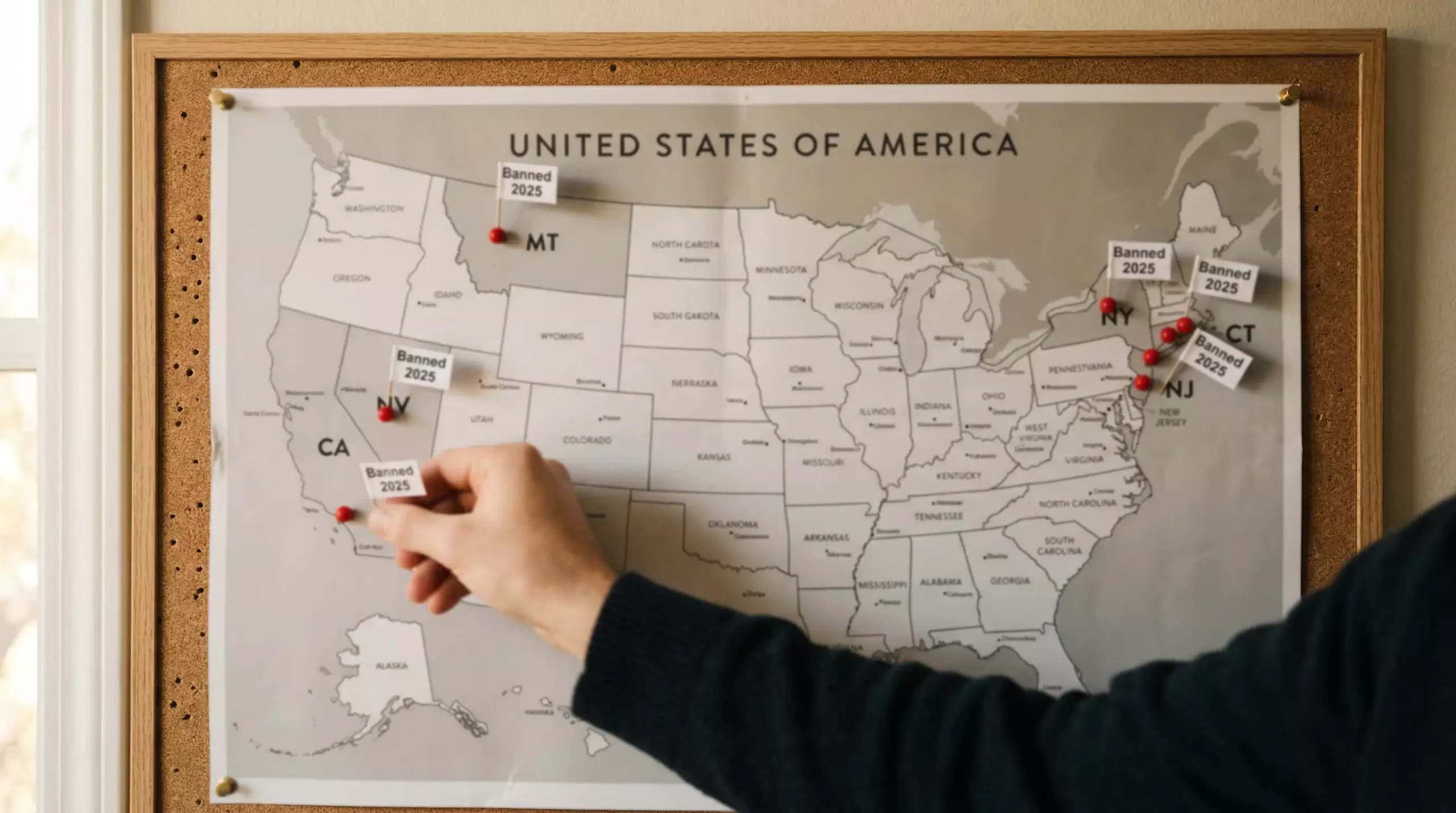
The year 2025 was the sweepstakes casino industry's regulatory reckoning. Six states passed legislation explicitly banning sweepstakes casinos, the largest coordinated wave of regulatory action the sector has ever faced. Montana led the charge with SB 555, signed into law in May 2025 and effective October 1 — making it the first state to explicitly prohibit the sweepstakes casino model. Connecticut followed with SB 1235, New Jersey with A5447, and Nevada with SB 256, each approaching the prohibition from slightly different statutory angles but arriving at the same conclusion: sweepstakes casinos are gambling, and they are not licensed to operate.
California's AB 831 stands out for both its market impact and its legislative unanimity. The bill passed the Senate 36-0 and the Assembly 63-0 (with a repeat vote of 79-0), was signed by Governor Newsom on October 11, 2025, and took effect January 1, 2026. Penalties range from ,000 to ,000 per violation, with potential jail sentences of up to one year. The unanimous votes in both chambers are remarkable — in California's notoriously fractious legislature, sweepstakes casinos managed to unite every single voting member against them.
New York's approach combined executive enforcement with legislative prohibition. Attorney General Letitia James issued cease-and-desist orders to 26 sweepstakes platforms in June 2025, and all 26 complied by ceasing Sweeps Coin sales. "Online sweepstakes casinos are illegal, dangerous, and can seriously ruin people's finances," James stated in the accompanying press release. The legislature subsequently passed SB 5935A, making the ban permanent and statutory rather than dependent on enforcement discretion.
Beyond the six outright bans, state regulators across the country issued more than 100 cease-and-desist notices to sweepstakes operators in 2025. States including Arizona, Michigan, Louisiana, Maryland, Mississippi, Pennsylvania, and Illinois all took enforcement actions of varying scope, signaling a broader regulatory turn even in jurisdictions that have not passed specific ban legislation.
The litigation front has been equally aggressive. More than 100 class-action lawsuits were filed against sweepstakes casinos in 2025. VGW, the parent company of Chumba Casino, LuckyLand Slots, and Global Poker, has been named in more than 20 of these suits. Other operators including Stake.us, A1 Development, and B2 Services each face at least five pending class actions. The plaintiffs' theories vary — some allege illegal gambling, others consumer fraud, still others violations of state prize promotion statutes — but the volume of litigation itself represents a systemic challenge to the industry's legal positioning.
Perhaps the most consequential legal action of 2025, however, was not a ban or a class action but a tax case. Louisiana's Department of Revenue sued VGW for .5 million and WOW Vegas for .6 million — a combined million — alleging unpaid sales taxes on virtual currency purchases. This was the first time a state had treated sweepstakes coin sales as taxable transactions, establishing a precedent that could cascade across every jurisdiction where sweepstakes platforms operate. If virtual currency purchases are subject to sales tax, the economic model of the entire industry changes fundamentally.
Shawn Fluharty, President of the National Council of Legislators from Gaming States and a West Virginia delegate, described the legislative momentum as unifying: the issue has brought lawmakers from both parties together around the view that sweepstakes casinos represent both illegal gambling and revenue theft in states that have invested in regulated gaming frameworks.
State-by-State Availability: Where Sweepstakes Slots Operate and Where They Don't
The geography of sweepstakes casino availability in 2026 is defined by absence: six states with explicit bans, a handful with aggressive enforcement postures, and the remaining 40-plus where platforms operate with minimal regulatory friction. The distribution of revenue across this map reveals which markets matter most to the industry — and which losses from the 2025 ban wave will be hardest to replace.
California was the largest sweepstakes casino market in the world before AB 831 took effect, generating an estimated .42 billion in sales — 17.3% of the entire US market. Losing California did not just remove a state; it removed nearly a fifth of the industry's total addressable market in a single regulatory action. The impact of AB 831 extends beyond revenue — California's ban also deprived operators of their most lucrative customer acquisition funnel.
New York represented the second-largest market at 2 million in sales during 2024, before the AG's enforcement actions and subsequent legislative ban shut it down. Together, California and New York accounted for roughly .2 billion in sweepstakes revenue — more than the entire market's net revenue figure and roughly the GDP of a small Caribbean nation.
The states that remain accessible are where the industry's future will be determined. Texas leads active markets at .41 billion in sales (up 112% year-over-year), followed by Florida at .12 billion (up 78%). Both states lack dedicated sweepstakes bans, but both have existing gambling regulatory frameworks that could be leveraged against operators if political will materializes. Texas's constitutional prohibition on most forms of gambling creates a particularly complex backdrop — sweepstakes platforms thrive there precisely because the state has no legal casino infrastructure to compete with.
The player distribution data reinforces the regulatory patchwork's impact. According to AGA survey data, the number of sweepstakes casino players in states without explicit bans is roughly double that of states with bans or active enforcement. This doubling effect suggests that regulatory action does reduce participation — but it also means that the remaining open states absorb some portion of displaced demand, as players in banned states either stop playing or find workarounds.
The six banned states — Montana, Connecticut, New Jersey, Nevada, California, and New York — represent a diverse cross-section of the US gambling regulatory landscape. Montana and Nevada have established casino industries protecting their turf. California and New York have powerful state attorneys general with political incentives to act. Connecticut and New Jersey have regulated iGaming markets that sweepstakes platforms were directly cannibalizing. The pattern suggests that future bans are most likely in states where an existing regulated gambling industry provides both the political motivation and the lobbying resources to push legislation through.
Sweepstakes Casinos vs Licensed iGaming: Scale, Access, and Oversight
The most clarifying comparison in the US gambling market is between sweepstakes casinos and licensed iGaming — two digital gambling products that offer functionally identical experiences to players while operating under radically different regulatory regimes. The numbers make the disparity stark.
VGW alone — one company operating Chumba Casino, LuckyLand Slots, and Global Poker — reported approximately US billion in revenue for FY2024. That single sweepstakes operator's revenue is equivalent to roughly two-thirds of the entire US licensed iGaming market, which generated .2 billion across all seven legal states combined. One unregulated company is matching the combined output of every regulated online casino in America.
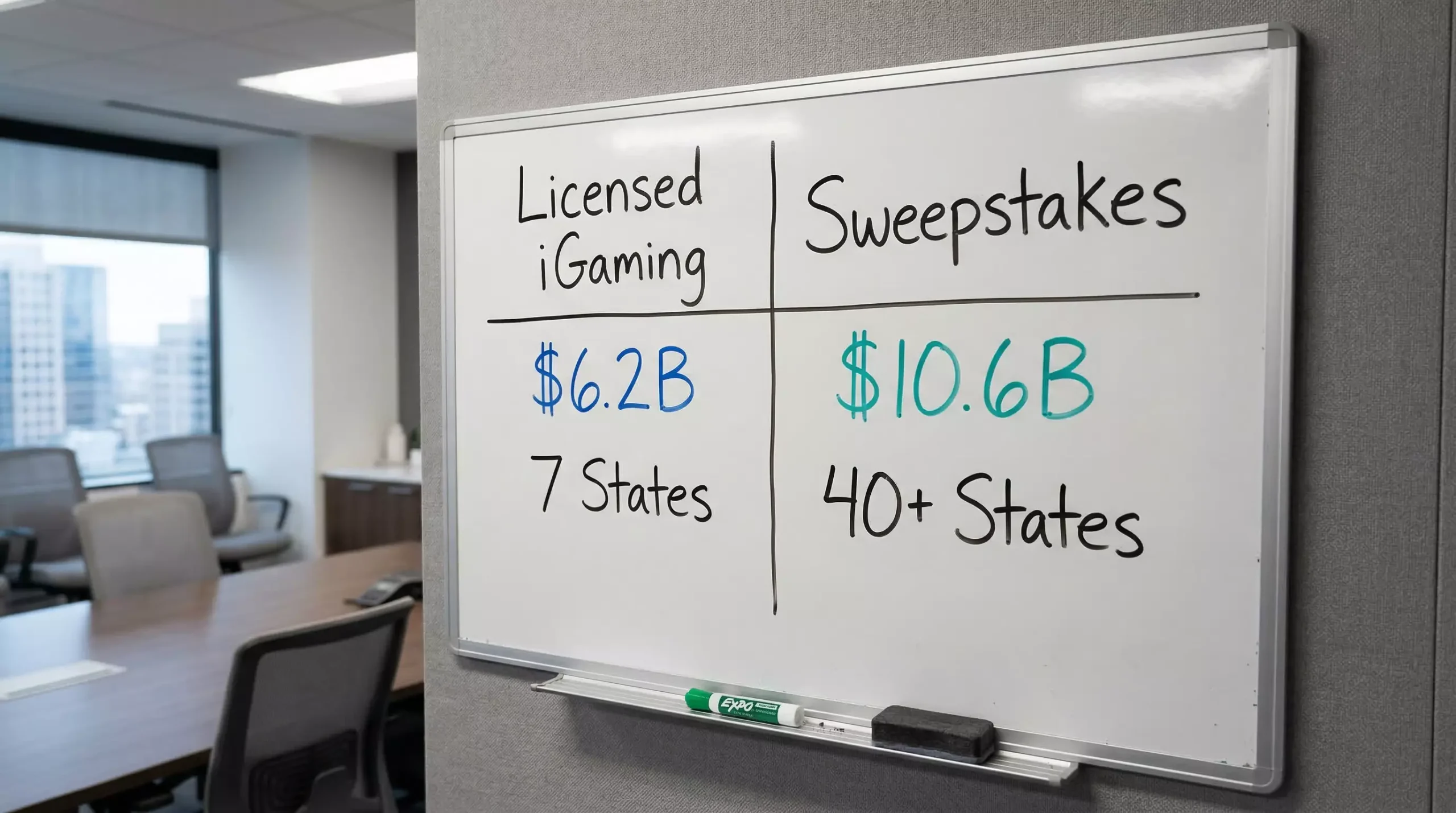
The access differential explains much of the revenue gap. Licensed iGaming is available in seven states: New Jersey, Pennsylvania, Michigan, Connecticut, West Virginia, Delaware, and Rhode Island. Sweepstakes casinos operate in 40-plus states — reaching players in every major population center that iGaming cannot touch. Texas, Florida, Ohio, Illinois, Georgia — all major markets where online casino gambling is illegal but sweepstakes platforms are a browser tab away.
Dan Hartman, a senior advisor at GMA Consulting and former director of the Colorado Division of Gaming, framed the tension between the two models directly at the 2025 NCLGS conference: licensed operators pay substantial fees to obtain state licenses and comply with regulatory requirements, while sweepstakes operators have effectively found a way around those barriers.
The revenue comparison extends beyond individual operators. KPMG data shows the global social casino market at .1 billion in gross revenue for 2024, with analysts projecting stagnation through 2027 due to competition from sweepstakes platforms. Sweepstakes casinos have not only overtaken social casinos in revenue (.6 billion vs .1 billion) — they are actively cannibalizing the older format by offering the one thing social casinos cannot: cash redemption.
| Dimension | Licensed iGaming | Sweepstakes Casinos |
|---|---|---|
| US states available | 7 | 40+ |
| Regulatory oversight | State gaming commissions | None (voluntary only) |
| Market revenue (2024) | .2B (all operators) | .6B gross / .4B net |
| Largest operator revenue | Varies by state | VGW: ~B |
| RTP verification | Mandatory third-party audit | Voluntary |
| Player protections | State-mandated (deposit limits, self-exclusion, cooling-off) | Operator-discretionary |
| Tax contribution | State gaming taxes + licensing fees | Minimal to none (contested) |
The broader context adds another layer. According to AGA estimates, unregulated operators — a category that includes sweepstakes casinos alongside offshore sportsbooks and illegal online casinos — accepted approximately 9 billion in wagers in 2024. The sweepstakes segment represents the most visible and commercially significant portion of that unregulated economy, and its continued operation outside licensing frameworks is the central policy question facing state gambling regulators.
Market Data and Forecasts: From Hypergrowth to Contraction
The KPMG projections published in early 2025 painted a bullish picture: gross revenue exceeding .3 billion and net revenue surpassing .6 billion for the full year 2025. Those estimates were based on the industry's multi-year growth trend and did not fully account for the regulatory backlash that accelerated through the second half of the year.
By September 2025, the forecast landscape had shifted dramatically. Eilers & Krejcik Gaming revised their net revenue projection for 2025 from .7 billion to billion — a reduction reflecting growth of 16% instead of the 36% they had originally modeled. More significantly, their base case scenario for 2026 calls for a 10% decline to approximately .6 billion in net revenue, the first year-over-year contraction in the industry's history. The primary drivers: the loss of California and New York, the chilling effect of 100-plus cease-and-desist orders, and the uncertain legal environment discouraging new player acquisition spending.
VGW's financials provide a window into the economics of the market's dominant player. For the fiscal year ending June 30, 2024, VGW reported revenue of A.1 billion (approximately US billion), an increase of 27% year-over-year, with net profit of A1.6 million (~US1.6 million), up 33%. The company paid out .83 billion in sweepstakes prizes during the period, compared to .2 billion in the prior fiscal year. These figures position VGW not just as the sweepstakes market leader but as one of the most profitable digital gambling companies operating in the United States — licensed or otherwise.
The total US gambling market reached 2 billion in 2024, a figure that emphatically does not include sweepstakes casino revenue. This exclusion matters for understanding both the market's scale and its policy implications. Sweepstakes casinos represent roughly 6% of total US gambling spend by volume, but they contribute nothing to state gaming tax revenues, fund no regulatory agencies, and support none of the responsible gambling infrastructure that the 2 billion in tracked spending helps finance.
The demographic profile of the player base adds economic context. AGA survey data shows that 35% of sweepstakes casino players are between 31 and 40 years old, with 27% in the 41-50 range and 22% between 21 and 30. The gender split is nearly even at 51% male and 49% female. The income data is the most policy-relevant finding: 42% of players report household income below ,000 per year, and 38% have no education beyond a high school diploma. This is not a high-income discretionary entertainment audience — it is a demographically vulnerable population spending money on an unregulated product with no guaranteed fairness standards.
Responsible Gaming: The Gap Between Need and Infrastructure
The academic evidence on online slot gambling and problem gambling risk is unambiguous. A 2024 meta-analysis published in The Lancet Public Health found that 15.8% of adults who play online slots and casino games meet criteria for problem gambling — the highest rate among all gambling formats studied. That figure carries a 95% confidence interval of 10.7% to 21.6%, meaning even the lower bound represents roughly one in ten players experiencing clinically significant harm. Sweepstakes casinos offer exactly this product category — online slots — to a population with limited protections.
The motivation data from AGA's 2025 survey compounds the concern. Sixty-eight percent of sweepstakes casino players report that winning real money is their primary motivation for playing. Eighty percent spend money on the platforms monthly, and approximately half spend weekly. These are not casual entertainment users dipping in occasionally — they are regular, money-motivated participants in a product with gambling mechanics and gambling outcomes.
What separates sweepstakes casinos from their licensed counterparts on the responsible gaming front is not that regulated platforms have perfect tools — they do not — but that they have any mandatory standards at all. Licensed iGaming operators in states like New Jersey and Pennsylvania are required to offer deposit limits, loss limits, session time reminders, cooling-off periods, and self-exclusion programs linked to statewide registries. Sweepstakes casinos may offer some of these features voluntarily, but there is no mandate, no standardization, and no enforcement mechanism if they do not.
The absence of standardized responsible gaming tools in the sweepstakes sector is not a theoretical problem. When 42% of the player base earns under ,000 annually, 68% are motivated by money, and 80% spend monthly, the conditions for financial harm are structurally present. The question is not whether harm occurs but at what scale, and the industry's regulatory exemption means that nobody is measuring.
"We need a federal presence like we have for cigarettes, alcohol, and other forms of addiction," argued Lia Nower, Director of the Center for Gambling Studies at Rutgers University, speaking at a 2025 Harvard panel on online gambling. Nower's call for federal-level oversight reflects a growing academic consensus that state-by-state regulation is insufficient for an industry that operates across all state lines through a web browser.
The responsible gaming gap in sweepstakes casinos is structural, not incidental. Licensed gambling products in the US operate within a framework that — however imperfectly — requires operators to invest in harm reduction. Sweepstakes casinos exist outside that framework entirely. The result is a .6 billion market serving a demonstrably vulnerable population with no mandatory safeguards and no independent measurement of the harm it produces.
Frequently Asked Questions About Sweepstakes Slot Machines
What are sweepstakes slots and how do they differ from regular online slots?
Sweepstakes slots are online slot machines operated under a promotional sweepstakes framework rather than a gambling license. The core mechanical difference is the dual-currency system: players purchase Gold Coins (which have no cash value) and receive Sweeps Coins as a promotional bonus. Only Sweeps Coins can be redeemed for cash prizes. Regular online slots in licensed iGaming states operate under direct wager-and-win mechanics with state-regulated oversight. In terms of gameplay experience, sweepstakes slots are often identical to their licensed counterparts — same providers, same titles, same visual presentation. The differences are legal and regulatory: sweepstakes platforms are not required to publish verified RTP data, pass mandatory RNG audits, or comply with state-mandated responsible gaming standards. The games may look the same, but the consumer protections behind them are fundamentally different.
Are sweepstakes casinos legal in the United States?
The legal status of sweepstakes casinos varies by state and is actively evolving. As of January 2026, six states have passed laws explicitly banning sweepstakes casinos: Montana (SB 555), Connecticut (SB 1235), New Jersey (A5447), Nevada (SB 256), California (AB 831), and New York (SB 5935A). In these states, operating or participating in sweepstakes casino platforms is illegal. In the remaining 40-plus states, sweepstakes casinos operate in a legal gray area. They are not explicitly licensed or regulated as gambling, but they are also not explicitly prohibited. State regulators in Arizona, Michigan, Louisiana, Pennsylvania, and several other states have issued cease-and-desist orders to individual operators without passing comprehensive ban legislation. The sweepstakes industry argues that its promotional model does not constitute gambling because free entry methods eliminate the "consideration" element. Multiple state attorneys general disagree, and the legal landscape is shifting rapidly toward greater restriction.
Can you win real money at sweepstakes casinos?
Yes, sweepstakes casinos allow players to redeem Sweeps Coins for cash prizes, typically at a rate of 1 SC to USD. However, several conditions apply. Players must accumulate a minimum balance of Sweeps Coins (usually 50-100 SC, depending on the platform) before redemption is available. Identity verification through a KYC (Know Your Customer) process is required before any cash-out, which typically involves submitting government-issued ID and proof of address. Processing times vary from 24 hours to several business days depending on the platform and payment method. VGW, the industry's largest operator, reported paying out .83 billion in prizes during its 2024 fiscal year. It is worth noting that sweepstakes winnings are treated as taxable income by the IRS, and Louisiana's 2025 lawsuit against VGW for .5 million in unpaid sales taxes suggests that the tax treatment of virtual currency purchases may also change. Players should be aware that while real money can be won, the odds and return-to-player percentages on sweepstakes slots are not independently verified by regulators the way they are in licensed iGaming states.
Methodology and Sources
This data-first analysis draws on primary research from institutional sources rather than operator marketing materials or affiliate-generated content. Market size and growth figures are sourced from KPMG's 2025 gaming industry primer, which incorporates data from Eilers & Krejcik Gaming's Social Sweepstakes Gaming Monitor (1Q25) — the industry's most widely cited proprietary dataset. Forecast revisions reference Eilers & Krejcik's September 2025 update as reported by industry outlets.
Regulatory data — including state bans, cease-and-desist actions, and legislative details — comes from primary government sources: the New York Attorney General's office, the California Senate analysis of AB 831, and reporting from iGaming Business and Gambling Insider that aggregates multi-state enforcement actions. Player demographic and behavioral data is drawn from the American Gaming Association's 2025 Sweepstakes Casino Player Profile & Advertising Trends report, based on an Interpret survey of 2,250 respondents conducted in June 2025.
Problem gambling prevalence data references a 2024 meta-analysis published in The Lancet Public Health (Tran LT et al., 2024; 9(8): e594-e613). Operator financial data is based on VGW's FY2024 annual report as covered by SBC Americas and Casino Industry News. All statistics are cited with their original publication dates, and where projections have been revised, both the original and updated figures are provided for context. This guide does not rely on operator-supplied RTP or payout claims, as these cannot be independently verified in the absence of regulatory oversight.