
Sweepstakes Casinos vs Licensed iGaming: Revenue, Regulation, and What Players Actually Get
 Available in GB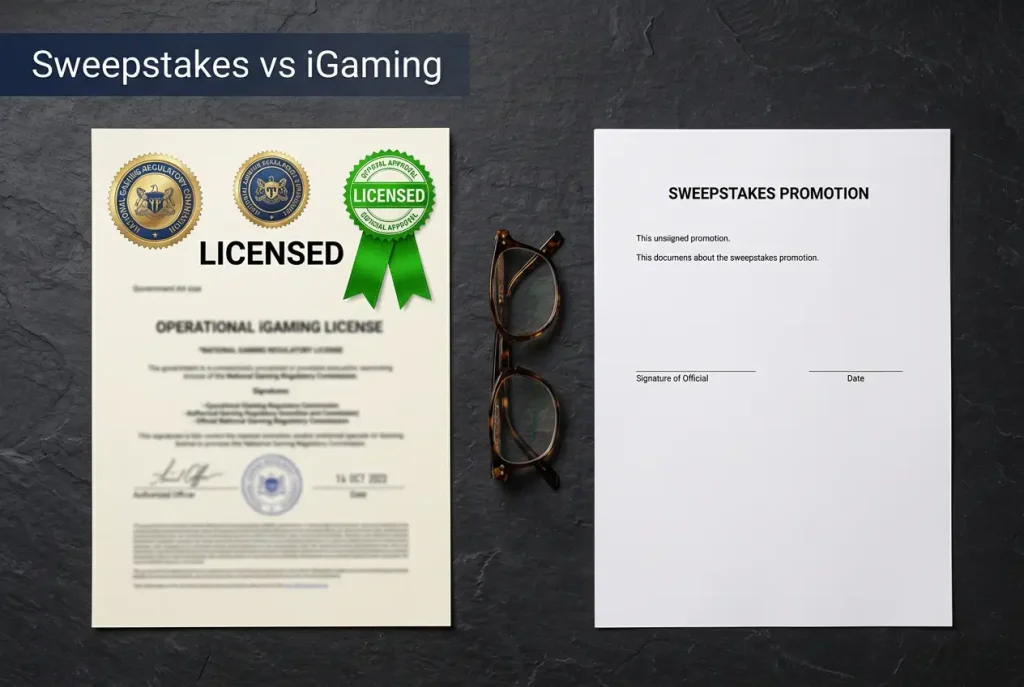
If you want to understand the difference between sweepstakes casinos and real-money casino platforms, start with a single number. VGW Group — the Australian company behind Chumba Casino and LuckyLand Slots — reported approximately US$4 billion in revenue for its 2026 fiscal year. The entire regulated iGaming market in the United States — all seven states with licensed online casino operations combined — generated $6.2 billion in the same period. One sweepstakes company, operating without a single state gambling license, produced two-thirds of what every licensed online casino in America earned collectively.
These are not competitors of different sizes playing the same game. They are parallel universes with different rules. Licensed iGaming operators pay millions for state licenses, submit to rigorous background investigations, comply with mandated responsible gaming standards, and remit gaming taxes that range from 15% to 51% of gross revenue depending on the jurisdiction. Sweepstakes casinos pay no licensing fees, submit to no background checks, follow no mandated responsible gaming standards, and until very recently, paid no gaming taxes at all.
This article compares the two models across every dimension that matters to players and to the broader gambling ecosystem: licensing and entry costs, revenue scale, consumer protection, tax treatment, and the growing question of whether these parallel universes are destined to converge. The data does the arguing. Your job is to decide what it means.
Licensing: Millions in Compliance vs. Zero Barriers to Entry
In the seven US states where online casino gambling is legal — New Jersey, Pennsylvania, Michigan, West Virginia, Connecticut, Delaware, and Rhode Island — obtaining an iGaming license is an expensive, exhaustive process. Applicants undergo multi-year background investigations that scrutinize financial records, criminal history, business associations, and corporate structure. In New Jersey, the Division of Gaming Enforcement conducts investigations that can take 12 to 18 months and cost applicants hundreds of thousands of dollars in legal and administrative fees before a single bet is placed.
The license itself comes with ongoing obligations: compliance departments staffed with trained personnel, regular audits by state gaming commissions, mandatory reporting of suspicious activity, adherence to advertising standards, and submission to random inspections. Operators must maintain minimum capital reserves to ensure they can cover player balances. They must use approved payment processors. They must demonstrate that their games meet technical standards for fairness and randomness. The cost of maintaining a state gaming license — between regulatory fees, compliance staff, legal counsel, and technology requirements — runs into the millions annually for a mid-sized operator.
Sweepstakes casinos bypass this entire infrastructure. Because they classify themselves as promotional sweepstakes rather than gambling operations, they are not required to obtain gaming licenses in any state. There is no background check. There is no minimum capital requirement. There is no mandatory compliance department. There is no state gaming commission reviewing their operations. The barrier to entry is, in regulatory terms, effectively zero — which helps explain why the number of active sweepstakes brands in the US grew to an estimated 150 to 190 or more by late 2026, with over 25 new platforms launching that year alone.
Dan Hartman, a senior consultant at GMA Consulting and former director of the Colorado Division of Gaming, framed the disparity in pointed terms at the NCLGS Conference in 2026: “The one thing I’ve said all along is you can’t all break in through the backdoor. Companies pay a lot to get licensed and do the things they do in our state.”
Hartman’s point resonates with licensed operators who view sweepstakes casinos as free riders on a regulatory system that everyone else pays to maintain. A licensed iGaming platform in Pennsylvania has spent millions to prove it meets the state’s standards for consumer protection, financial stability, and operational integrity. A sweepstakes casino operating in the same state has spent nothing on any of those things — and offers a product that, from the player’s perspective, is often indistinguishable from what the licensed platform provides.
The licensing gap doesn’t just create competitive inequality — it creates a consumer information problem. When a player uses a licensed platform in New Jersey, they know that the state’s Division of Gaming Enforcement has vetted the operator, tested the games, and established a mechanism for resolving disputes. When a player uses a sweepstakes casino, they have no equivalent assurance. The platform’s trustworthiness is a matter of faith, not regulation.
Revenue: How an Unregulated Market Outgrew Seven States of Licensed Gambling
The revenue comparison between sweepstakes casinos and licensed iGaming isn’t close, and it hasn’t been for years. According to KPMG’s 2026 analysis of Eilers & Krejcik Gaming data, US sweepstakes casinos generated $10.6 billion in gross revenue (total player purchases) in 2026, with $3.4 billion in net revenue after prize payouts. The regulated US iGaming market — seven states with full online casino licensing — produced approximately $6.2 billion in gross gaming revenue over the same period.
To put it bluntly: sweepstakes casinos, operating without licenses and outside the regulated gambling framework, generated nearly 70% more in gross revenue than the entire licensed online casino industry. And this comparison understates the gap, because it uses gross revenue for sweepstakes against gross gaming revenue for iGaming — different metrics that aren’t perfectly analogous. The point, though, is directionally unmistakable.
VGW Group alone accounts for a staggering share of this market. With approximately US$4 billion in revenue for fiscal year 2026 — up 27% year-over-year — VGW’s single-company output represents roughly two-thirds of what the entire licensed iGaming sector generates across seven states. The company also reported net profit of approximately US$322 million (+33% year-over-year) and paid out $2.83 billion in sweepstakes prizes, up from $2.2 billion the prior year.
The social casino market provides another useful benchmark. KPMG’s report pegs global social casino gross revenue at $7.1 billion for 2026, with analysts forecasting stagnation through 2027 — partly because sweepstakes casinos have been cannibalizing social casino players by offering something social casinos don’t: a path to real money. When a player can choose between a social casino where winnings have no cash value and a sweepstakes casino where winnings can be redeemed for real prizes, the choice is obvious for anyone motivated by financial returns.
Meanwhile, the total US gambling market — encompassing commercial casinos, tribal gaming, sports betting, lottery, and iGaming — generated $172 billion in consumer spending in 2026, up 3.3% year-over-year. Sweepstakes casino revenue is not included in that figure. An entire $10.6 billion market segment exists in a statistical blind spot, uncounted in official industry totals because it officially isn’t gambling. For context, $10.6 billion exceeds the total gaming revenue of most individual US states.
The revenue picture explains much of the political energy behind the 2026 ban wave. State legislators in California, New York, and elsewhere weren’t just responding to consumer protection concerns — they were looking at billions of dollars in economic activity generating zero licensing fees, zero gaming taxes, and zero regulatory oversight in their jurisdictions. The revenue gap between sweepstakes and iGaming isn’t just a market curiosity; it’s a policy failure that six states decided they could no longer tolerate.
Consumer Protection: Mandatory Safeguards vs. Voluntary Gestures
The consumer protection gap between licensed iGaming and sweepstakes casinos is arguably the most consequential difference between the two models — and the one most directly relevant to players. In regulated states, players have legal recourse: they can file complaints with state gaming commissions, which have the authority to investigate, mediate, and impose penalties on operators. In the sweepstakes space, a player with a complaint has no regulatory body to turn to.
In regulated iGaming states, operators must comply with a suite of mandatory player protection measures. These typically include deposit limits (players set maximum amounts they can fund per day, week, or month), session time limits, reality check notifications that interrupt play at set intervals, self-exclusion registries that allow players to ban themselves from all licensed platforms in the state, and cool-off periods that prevent recently excluded players from re-enrolling immediately. Operators must also provide clear links to problem gambling resources, train customer service staff to recognize signs of disordered play, and file suspicious activity reports when player behavior suggests potential harm.
Return-to-player rates must be audited and certified by independent testing laboratories, and results must meet minimum thresholds set by the state gaming commission. In New Jersey, for example, online slots must return at least 83% to players over time. In practice, most licensed online slots operate at 94–97% RTP, but the regulatory floor ensures that games can’t be configured to retain unreasonable amounts of player money without consequences.
Sweepstakes casinos have none of these requirements. Some platforms offer voluntary responsible gaming tools — deposit limits, session reminders, self-exclusion options — but these are implemented at the operator’s discretion, with no external oversight to verify they function as described. No state gaming commission audits sweepstakes platforms’ responsible gaming implementations. No regulator verifies that a self-exclusion request is properly honored. No independent testing lab is required to certify RTP rates.
Tres York, the American Gaming Association’s vice president for government relations, summarized the disparity in stark terms: “These operators present themselves like legal, regulated platforms — but they operate outside the law and regulation. There are few if any responsible gaming tools, no regulatory oversight and no consumer protections. It’s a dangerous subterfuge that puts players at real risk.”
The stakes of this gap are underscored by research. A 2026 meta-analysis published in The Lancet Public Health found that 15.8% of adults who play online slots or casino games meet the criteria for problem gambling — the highest rate among all gambling formats studied. Online slots are, by the available evidence, the gambling product most strongly associated with disordered play. And sweepstakes casinos deliver this product without any of the harm-mitigation infrastructure that licensed platforms are required to maintain.
The consumer protection comparison becomes particularly troubling when overlaid with demographic data. As documented in the AGA’s 2026 player profile study, 42% of sweepstakes casino users have household incomes below $50,000 — a population that is both more likely to experience financial harm from gambling losses and less likely to have access to resources for recovery. Licensed iGaming platforms aren’t perfect on this front, but they at least operate within a framework designed to identify and mitigate harm. Sweepstakes casinos operate in a framework designed to maximize engagement with no external checks on how far that engagement goes.
Tax Treatment: Billions in Revenue, Zero in State Gaming Taxes
Licensed iGaming operators pay gaming taxes — and they pay a lot. State tax rates on gross gaming revenue vary widely, from around 15% in states like Michigan and New Jersey to 51% in New York (the highest iGaming tax rate in the country, and one that operators have loudly protested). These taxes fund state budgets, problem gambling treatment programs, and regulatory infrastructure. In Pennsylvania, iGaming taxes generated hundreds of millions in annual state revenue. Across all seven licensed states, the combined gaming tax take runs into the billions.
Sweepstakes casinos historically paid nothing. Because they classify their operations as promotional sweepstakes rather than gambling, they have not been subject to gaming taxes in any jurisdiction. They haven’t paid licensing fees. They haven’t contributed to problem gambling funds. The $10.6 billion in gross revenue generated by the sweepstakes industry in 2026 produced zero dollars in state gaming tax revenue.
That arrangement is now under direct legal challenge. In September 2026, the Louisiana Department of Revenue filed claims totaling approximately $44 million against VGW ($32.5 million) and WOW Vegas ($13.6 million) for unpaid sales tax on virtual currency purchases. Louisiana’s argument is straightforward: when a player buys a Gold Coin package, they are purchasing a digital good, and that transaction is subject to the state’s sales tax. The fact that Sweeps Coins are included as a “free promotional bonus” doesn’t change the taxable nature of the underlying purchase.
The Louisiana case is the first tax enforcement action against sweepstakes operators at the state level, and its outcome could have cascading consequences. If Louisiana prevails, every state with a sales tax on digital goods has a potential claim against every sweepstakes platform that processed virtual currency purchases within its borders. The retroactive tax exposure — years of untaxed transactions across dozens of states — could be substantial enough to threaten the financial viability of smaller operators.
VGW’s response was telling. After the Louisiana filing, the company began voluntarily collecting sales tax in certain jurisdictions — an acknowledgment, implicit or otherwise, that the tax argument has enough merit to warrant compliance. Whether this was a strategic decision to reduce future liability or a genuine shift toward tax compliance, it signals that the industry’s zero-tax era is ending.
The broader context amplifies the significance. According to AGA estimates, unregulated operators — a category that includes sweepstakes casinos — accepted approximately $109 billion in wagers in 2026. Whether or not that figure is precisely right, the scale of untaxed gambling activity is large enough to make state budget offices pay attention. The combination of lost gaming tax revenue, lost licensing fees, and the Louisiana precedent is creating fiscal pressure that reinforces the regulatory pressure already coming from consumer protection and law enforcement angles.
Convergence: Can Two Parallel Universes Merge?
The most interesting question in the sweepstakes vs iGaming comparison isn’t about the differences — it’s about whether those differences are sustainable. The industry is betting they aren’t. The Social Gaming Leadership Alliance, the trade group representing sweepstakes operators, has abandoned its longstanding position that sweepstakes casinos aren’t gambling and pivoted to asking for regulation.
Jeff Duncan, the SGLA’s executive director and a former congressman, made the case directly at the NCLGS Winter Conference in December 2026: “We want to be regulated. We want to pay taxes. […] In a regulated, taxed environment, there is an opportunity to help the budget of the states that are struggling.” The pitch is straightforward: rather than banning sweepstakes casinos, states should create a licensing framework that brings them into the regulated fold, generating tax revenue and enabling consumer protection oversight in the process.
Not everyone finds the pitch convincing. Shawn Fluharty, president of the NCLGS and a West Virginia state delegate, offered a pointed rejoinder at the same conference: “[Their pivot to call for regulation] is a great pivot, great politicking, but not great policy. Redeemability to real money is the real issue.” Fluharty’s argument cuts to the core of the convergence question: if sweepstakes casinos accept regulation, they would need to comply with the same standards that licensed iGaming operators meet — background checks, capital requirements, responsible gaming mandates, RTP audits, tax obligations. At that point, a “regulated sweepstakes casino” is functionally indistinguishable from a licensed online casino. The sweepstakes model’s competitive advantage — lower operating costs driven by zero regulatory burden — evaporates entirely.
Three scenarios seem plausible for the medium-term future. In the first, the ban wave continues and additional states prohibit sweepstakes casinos outright, shrinking the addressable market until the model becomes economically unviable at scale. In the second, a handful of states create sweepstakes-specific licensing frameworks — lighter than full iGaming licenses but heavier than the current no-regulation status quo — that allow operators to continue under modified rules. In the third, federal legislation establishes a national standard, either banning sweepstakes casinos entirely or creating a federal licensing structure.
Each scenario has significant obstacles. Continued state-by-state bans leave a fragmented legal landscape that operators can navigate by retreating to permissive jurisdictions. State-level licensing frameworks require legislative action in dozens of individual states, a process that moves slowly and produces inconsistent results. Federal legislation faces the same political obstacles that have blocked comprehensive online gambling reform for decades.
What seems unlikely is the status quo. The parallel universes of sweepstakes and iGaming operated in separate orbits for years, but the 2026 ban wave, the Louisiana tax case, and the SGLA’s pivot toward regulation all suggest that the distance between them is closing. Whether they merge through regulation, separation through prohibition, or fragmentation through state-by-state inconsistency, the relationship between sweepstakes casinos and licensed iGaming is entering a phase of active renegotiation — one that will reshape both industries in 2026 and beyond.
Sweepstakes Casinos vs Licensed iGaming — More on this topic at sweepstakes slot machines.
See also Are Sweepstakes Slots Fair? RTP Claims, RNG Audits, and What Players….