
Sweepstakes Casino Market in Numbers: $10.6B Revenue, 60% CAGR, and the Coming Slowdown
 Available in GB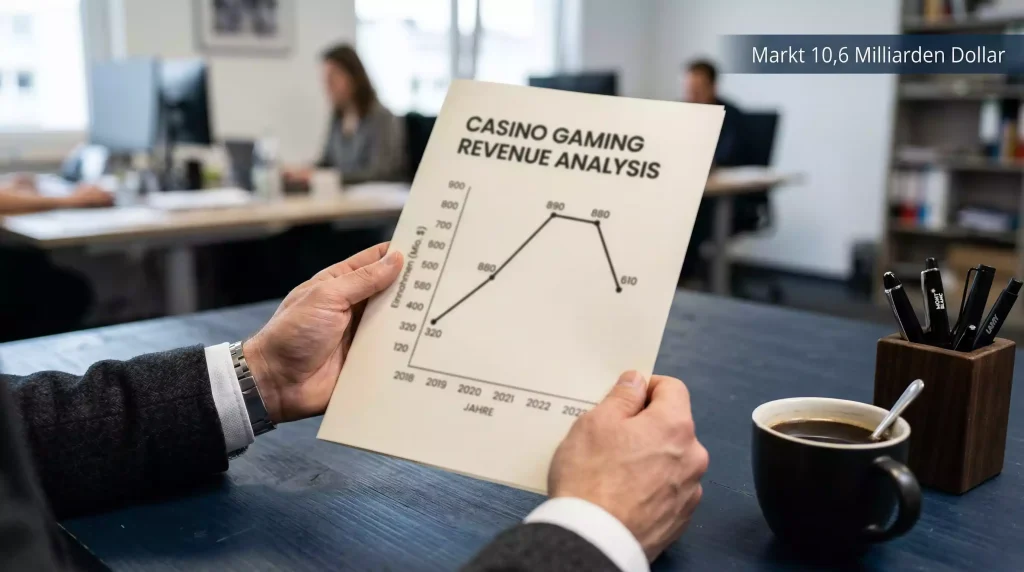
The sweepstakes casino market in 2026 finds itself in unfamiliar territory. For four consecutive years, the industry posted compound annual growth rates between 60% and 70%, expanding from a niche segment into a $10.6 billion gross revenue market by 2026. The trajectory looked unstoppable — until regulators stopped it. Six state bans in 2026, over a hundred cease-and-desist orders, and more than a hundred class-action lawsuits forced Eilers & Krejcik Gaming to do something they had never done for this sector: revise their forecast downward.
The coming slowdown isn’t speculation — it’s the base-case scenario from the same analysts who tracked the industry’s explosive rise. Net revenue growth for 2026 was revised from 36% to 16%, and the 2026 projection calls for a 10% decline. If that forecast holds, the sweepstakes casino market will contract for the first time in its history.
This article assembles the numbers: market size and growth trajectory, state-level revenue distribution, operator financial performance, the forces driving contraction, and the demographic profile of the player base. The data comes from KPMG, Eilers & Krejcik Gaming, the American Gaming Association, UMG Gaming Nation, and operator financial disclosures. Together, these sources paint the most complete quantitative picture of an industry at a turning point — one where the numbers that defined the boom are now the numbers that define the correction.
Market Size: From $10.6 Billion in Revenue to a Revised Forecast
The most authoritative snapshot of the sweepstakes casino market comes from KPMG’s 2026 industry primer, which compiled Eilers & Krejcik Gaming data from their Social Sweepstakes Gaming Monitor. The headline figures for 2026: $10.6 billion in gross revenue (total player purchases of virtual currency) and $3.4 billion in net revenue (after sweepstakes prize payouts). These are not projections — they are reported figures based on operator financial data and market modeling.
To appreciate the scale of that number, consider the growth trajectory. In 2023, the market generated $5.6 billion in player purchases and $2 billion in net revenue, according to Eilers & Krejcik data reported via Casino Reports. That represented 61% year-over-year growth. The compound annual growth rate from 2019 to 2023 was approximately 85%. From 2020 to 2026, the CAGR moderated slightly to 60–70% — still extraordinary by any industry standard, and reflective of a market that was roughly doubling in size every 12 to 18 months during its peak growth period.
For comparison, the US sports betting market — itself considered a high-growth sector following the Supreme Court’s 2018 PASPA ruling — grew at a CAGR of approximately 30–40% over a similar period. The sweepstakes casino sector’s growth rate was roughly double that of sports betting, driven by low barriers to entry for operators, zero licensing costs, aggressive digital advertising, and the availability of the product in over 40 states compared to sports betting’s more limited geographic footprint.
Pre-ban forecasts for 2026 were accordingly aggressive. KPMG’s report cited Eilers & Krejcik projections of over $14.3 billion in gross revenue and over $4.6 billion in net revenue for 2026 — a continuation of the hyper-growth trend that had defined the sector since its emergence. Those forecasts, however, were compiled before the full impact of the 2026 regulatory actions became clear.
For context, total US gambling expenditure across all channels — commercial casinos, tribal gaming, sports betting, lottery, and licensed iGaming — reached $172 billion in 2026, up 3.3% year-over-year. The sweepstakes casino market’s $10.6 billion is not included in that total, because sweepstakes casinos are not classified as gambling operations in official industry statistics. This means that approximately 6% of all money Americans spent on activities that look, feel, and function like gambling exists in a statistical blind spot — counted by market analysts but invisible to the regulatory infrastructure that tracks the rest of the gambling industry.
The gap between the KPMG pre-ban projections and the revised Eilers & Krejcik forecasts (discussed in the growth-reversal section below) represents the financial cost of the regulatory reckoning: billions of dollars in projected revenue that will never materialize, redirected by legislative action into either the regulated gambling market, other entertainment spending, or nowhere at all.
State-by-State Revenue: Where the Money Comes From
The sweepstakes casino market is overwhelmingly American. According to Eilers & Krejcik Gaming data, 98% of all global sweepstakes casino revenue is generated in the United States. The remaining 2% comes from Canada, Australia, and a handful of other markets — negligible by comparison. For all practical purposes, when you talk about the sweepstakes casino industry, you’re talking about the US market. No other country has the combination of legal ambiguity, digital payment infrastructure, and population scale that allows the sweepstakes model to operate at this revenue level.
Within the US, revenue concentration is pronounced. California was the largest single-state market before its ban took effect, generating an estimated $2.42 billion in sweepstakes casino sales in 2026 — approximately 17.3% of the entire US market. By another measure, UMG Gaming Nation data pegged California at $1.68 billion with 91% year-over-year growth. The discrepancy between the two figures likely reflects different methodologies and time periods, but both sources agree on the fundamental point: California was far and away the most valuable sweepstakes market in the country, and its loss will be felt disproportionately by the industry.
New York was the second-largest market, with an estimated $762 million in sweepstakes casino sales in 2026. The combination of the California and New York bans alone removes access to markets that collectively represented well over $3 billion in annual sweepstakes sales — a staggering geographic contraction.
Among the states where sweepstakes casinos continue to operate, Texas and Florida stand out. UMG Gaming Nation data for 2026 shows Texas at $1.41 billion in sweepstakes sales (up 112% year-over-year) and Florida at $1.12 billion (up 78%). According to SGLA’s own economic report, Florida accounts for approximately 8.5% of sweepstakes operator revenue. Neither state has enacted a sweepstakes ban, though both have active discussions about regulation. If Texas or Florida were to follow the California-New York precedent, the industry would lose access to markets representing over $2.5 billion in additional annual sales.
The AGA’s 2026 player profile study added another dimension to the geographic picture: sweepstakes player counts roughly double in states without explicit bans compared to states with prohibitions. This finding confirms what the revenue data implies — that legislative action is effective at reducing sweepstakes activity, and that the remaining open-market states are absorbing disproportionate levels of engagement.
The geographic distribution of the market has implications beyond raw revenue. The states with the largest sweepstakes markets — Texas, Florida, and the now-banned California and New York — are also among the most populous and most politically influential states in the country. Regulatory decisions in these states set templates that smaller states often follow. The 2026 bans in California and New York may prove to be leading indicators for the rest of the country, or they may represent a ceiling that other states don’t reach. Which scenario unfolds will determine the shape of the market’s geographic footprint in 2026 and beyond.
Operator Financials: VGW and the Concentration Problem
No discussion of sweepstakes casino market data is complete without addressing VGW Group, the Melbourne-based company that dominates the sector. VGW operates Chumba Casino, LuckyLand Slots, and Global Poker — three of the most recognized brands in the sweepstakes space — and its financial results dwarf those of its closest competitors.
For the fiscal year ending June 30, 2026, VGW reported revenue of approximately A$6.1 billion (roughly US$4 billion), representing a 27% increase year-over-year. Net profit reached approximately A$491.6 million (US$322 million), up 33% from the prior year. The company paid out $2.83 billion in sweepstakes prizes, compared to $2.2 billion in the previous fiscal year. These are not startup-scale numbers — they are the financial metrics of a mature, highly profitable enterprise.
The scale of VGW’s operations becomes even more striking in comparative context. VGW’s approximately US$4 billion in revenue is comparable to roughly two-thirds of the entire US licensed iGaming market, which generated $6.2 billion across seven states in the same period. One company, operating without a gambling license in any jurisdiction, produces revenue equivalent to two-thirds of an industry that operates under comprehensive state regulation. That ratio is the single most revealing data point in the sweepstakes market.
Market concentration at VGW’s level creates systemic risk for the industry. When one company accounts for a substantial plurality of total market revenue, regulatory action against that company effectively becomes regulatory action against the industry. VGW is named in more than 20 class-action lawsuits, is the primary defendant in the Louisiana $44 million tax case, and was among the 26 platforms that received cease-and-desist orders from the New York Attorney General. Any adverse legal outcome for VGW would have outsized impact on the sweepstakes market as a whole.
Beyond VGW, the operator landscape includes Stake.us, WOW Vegas, McLuck, Pulsz, Fortune Coins, and dozens of smaller platforms. None of these operators report public financial results, which makes independent verification of their market share impossible. Industry estimates suggest that VGW controls somewhere between 35% and 50% of the US sweepstakes market — an unusually high concentration ratio for any consumer sector, and one that leaves the remaining operators competing for the other half of a market that may be shrinking.
What’s known is that the total number of active brands grew from around 50 in the early 2020s to an estimated 150 to 190 or more by late 2026, with over 25 new platforms launching in that year alone. This proliferation of smaller operators occurred even as regulatory pressure intensified — a dynamic that suggests the perceived upside of entering the market still outweighs the perceived risk for new entrants, at least at the lower end of the investment spectrum. Whether these new entrants can survive in a contracting market with rising legal costs is another question entirely.
Growth in Reverse: Why 2026 Will Be the First Year of Contraction
In September 2026, Eilers & Krejcik Gaming did something unprecedented for the sweepstakes casino sector: they revised their growth forecast downward. The firm’s updated projection cut 2026 net revenue expectations from $4.7 billion to $4 billion — reducing anticipated growth from 36% to 16%. More significantly, their base-case scenario for 2026 projects a 10% decline in net revenue, to approximately $3.6 billion. If that projection holds, 2026 will mark the first year of contraction in the industry’s history.
The drivers of the reversal are concrete and quantifiable. Six states banned sweepstakes casinos in 2026, removing access to markets that collectively represented billions in annual sales. California alone accounted for 17.3% of the US market. New York added another $762 million. Montana, Connecticut, New Jersey, and Nevada contributed smaller but still meaningful revenue losses. More than 100 cease-and-desist orders from state regulators across Arizona, Michigan, Louisiana, Maryland, Mississippi, Pennsylvania, and Illinois further constricted the operating environment. The cumulative effect is a market that is simultaneously losing access to its most valuable geographies and facing rising compliance costs in the jurisdictions that remain open.
The exit of Pragmatic Play from the US sweepstakes market added a supply-side constraint. Pragmatic had been the largest content provider to sweepstakes platforms, and its departure — motivated by regulatory risk and reputational concerns — left operators scrambling to fill gaps in their game catalogs. Studios like Hacksaw Gaming and BGaming absorbed some of the displaced demand, but the transition involved reduced content libraries for many platforms during a period when player engagement was already under pressure from the regulatory shakeout.
Shawn Fluharty, president of the National Council of Legislators from Gaming States, placed the contraction in a broader policy context at the NCLGS Winter Conference: “This issue has brought lawmakers together […] it represents illegal gambling and revenue theft in many states.” Fluharty’s characterization of sweepstakes revenue as “revenue theft” — revenue that would otherwise flow to regulated operators and state tax coffers — captures the political framing that drove the ban wave and continues to motivate additional legislative action.
The social casino market offers an instructive parallel. According to KPMG data, the global social casino market generated $7.1 billion in gross revenue in 2026, with analysts forecasting stagnation through 2027. Part of that stagnation is attributed to cannibalization by sweepstakes casinos, which offer something social casinos don’t: real-money prize redemption. If sweepstakes contraction slows the cannibalization trend, social casinos may stabilize — an outcome that would further complicate the competitive dynamics between regulated, unregulated, and non-gambling virtual casino formats.
Who Plays: The Demographic Profile of the Sweepstakes Market
The American Gaming Association’s 2026 Sweepstakes Casino Player Profile, based on a survey of 2,250 respondents conducted by Interpret in June 2026, provides the most granular demographic data available for the sweepstakes player base. The findings reveal a user population that is younger, more gender-balanced, and lower-income than most gambling industry benchmarks.
Age distribution skews decisively toward working-age adults. The largest cohort is 31–40 years old, accounting for 35% of all sweepstakes casino players. The 41–50 age group represents 27%, and the 21–30 group represents 22%. Players under 21 are excluded from most platforms (the minimum age is typically 18 or 21 depending on the state), and players over 50 are underrepresented relative to the general adult population. The concentration in the 31–40 range distinguishes sweepstakes casinos from both traditional brick-and-mortar casinos (which skew older) and mobile gaming platforms (which often skew younger).
The gender split is nearly even at 51% male and 49% female — a notably balanced ratio compared to other gambling verticals. Sports betting, for example, is overwhelmingly male. Traditional casino gambling historically skews male by a significant margin. The near-parity in sweepstakes casino demographics suggests that the platform format, marketing approach, or product design appeals broadly across gender lines — a characteristic that may also explain the sector’s rapid growth, as it effectively doubled the addressable audience compared to male-skewed gambling products.
Employment data shows that 71% of sweepstakes players work full-time, suggesting that the user base is primarily composed of working adults, not retirees or unemployed individuals. However, the income distribution tells a more complicated story. A striking 42% of sweepstakes casino players report household incomes below $50,000, and 38% have no formal education beyond a high school diploma. These figures are lower than the US median on both measures, indicating that sweepstakes casinos draw disproportionately from lower-income and lower-education demographics — the same populations that problem gambling research consistently identifies as more vulnerable to harm.
Spending behavior data from the same AGA study adds urgency to the demographic picture. Among players who have made purchases, 80% report spending on a monthly basis, and roughly 50% spend weekly. The primary motivation for 68% of players is winning real money — not entertainment, not social interaction, but financial gain. When a product is used with that frequency, driven by that motivation, by a population with that income profile, the comparison to traditional gambling becomes difficult to dismiss.
The advertising landscape reinforces these demographic patterns. According to AGA and Sensor Tower data, approximately 50% of all online casino advertising in the United States in early 2026 came from sweepstakes platforms — a share that dwarfed the advertising spend of licensed iGaming operators. The volume and targeting of this advertising is one mechanism by which sweepstakes casinos reach the demographic segments identified in the AGA survey, and the regulatory absence that permits sweepstakes platforms to advertise without the restrictions that licensed operators face gives them a structural advantage in customer acquisition.
The demographic data matters because it shapes the policy debate. Consumer advocates argue that sweepstakes casinos disproportionately attract players who are financially vulnerable and that the absence of mandated responsible gaming tools in the sweepstakes space compounds that vulnerability. Industry advocates counter that the data simply reflects broad access — sweepstakes casinos operate in over 40 states, while licensed iGaming is available in only seven, so a wider demographic spread is expected. Both arguments contain truth. What the data does not support is the characterization of sweepstakes casinos as harmless entertainment — the spending patterns, income profiles, and sheer scale of the market suggest something more consequential than that.
Sweepstakes Casino Market in Numbers — More on this topic at sweepstakes slot machines.
See also Gold Coins vs Sweeps Coins.