
Sweepstakes Casinos in Texas: A $1.41 Billion Market With No Dedicated Law
 Available in GB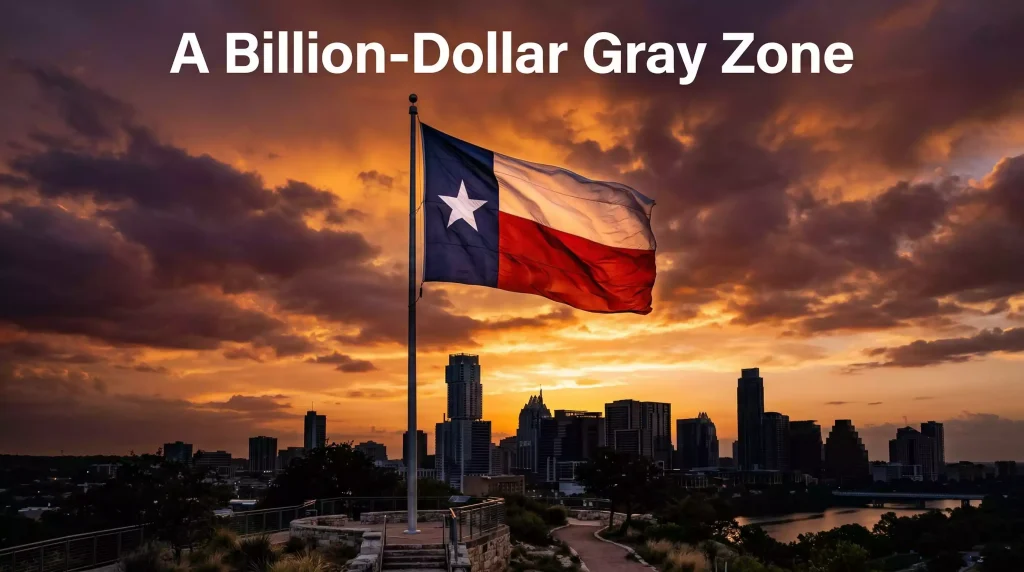
Texas is the largest sweepstakes casino market among states that haven’t passed a dedicated ban — $1.41 billion in player purchases in 2026, representing a staggering 112% year-over-year growth. That figure makes Texas the single biggest revenue generator for sweepstakes operators in the country, surpassing even California’s pre-ban numbers on a growth trajectory basis. And unlike California, New York, or the four other states that moved to prohibit sweepstakes casinos last year, Texas has no specific legislation addressing the industry — neither a ban nor a regulatory framework.
That absence of dedicated law creates what might be the largest regulatory gray zone in American gambling. Texas anti-gambling statutes are broad and have historically been used to target skill-game machines (eight-liners) in convenience stores, but their application to online sweepstakes platforms operating from servers outside the state is untested. The billion-dollar gray zone exists because nobody has yet forced the question into a definitive legal resolution — and the longer that resolution takes, the more deeply entrenched the industry becomes.
The Legal Gray Zone: Broad Statutes, No Specific Law
Texas gambling law is restrictive on paper but selectively enforced in practice. Chapter 47 of the Texas Penal Code criminalizes gambling, defined broadly as making a bet — risking anything of value on a contest of chance or the future value of anything. The statute includes exemptions for the state lottery, pari-mutuel horse and greyhound racing, and certain charitable bingo operations. Sweepstakes casinos are not listed among the exemptions, but they’re also not explicitly prohibited.
The legal ambiguity mirrors the sweepstakes industry’s national defense: operators argue that purchasing Gold Coins is a retail transaction (not a bet), Sweeps Coins are a promotional bonus (not consideration), and redemption is a prize award (not a gambling payout). This interpretation has never been tested in Texas courts. The state Attorney General’s office has not issued a formal opinion on whether online sweepstakes casinos violate Chapter 47, and no Texas regulator has sent cease-and-desist letters to sweepstakes operators.
Texas does have a complicated history with a related product — eight-liners. These arcade-style skill machines, found in gas stations and small gaming parlors across the state, exist in their own legal gray zone. Texas law permits eight-liners that offer non-cash prizes up to $5 per game, but enforcement against machines that allegedly exceed these limits has been inconsistent and geographically uneven. Some jurisdictions crack down aggressively; others ignore them entirely. The eight-liner precedent illustrates Texas’s general posture toward gray-area gambling: the statutes are broad enough to prohibit, but the enforcement appetite is limited by political priorities and resource constraints.
For online sweepstakes casinos, the Texas landscape currently offers de facto permissiveness through regulatory silence. No law says you can operate here. No law specifically says you can’t. And $1.41 billion in annual player purchases suggests that both operators and players have interpreted that silence as permission — a reading that could change abruptly if the political dynamics shift.
It’s also worth noting what doesn’t exist in Texas: there’s no state gaming commission with jurisdiction over online gambling, no established regulatory infrastructure for digital gaming products, and no licensing framework that sweepstakes operators could voluntarily enter even if they wanted to. In states like New Jersey, the Division of Gaming Enforcement provides a clear regulatory pathway. In Texas, there’s simply a void — no regulator to answer to, no standards to meet, and no state-level entity monitoring what happens between operators and the millions of Texas residents who use their platforms.
$1.41 Billion and Growing: The Texas Sweepstakes Market
The $1.41 billion figure — 112% growth over the prior year — positions Texas as the single largest active sweepstakes market in the U.S. following California’s ban. The growth rate is notable even by the industry’s historically aggressive standards. Several structural factors explain why Texas punches above its weight in sweepstakes revenue.
Texas has no legal iGaming market. Unlike New Jersey, Michigan, or Pennsylvania — states where licensed online casinos offer regulated alternatives — Texas residents who want to play slot-style games online have essentially two options: offshore gambling sites (illegal under both state and federal law) or sweepstakes casinos (legally ambiguous). The absence of a regulated competitor funnels demand toward sweepstakes platforms by default.
The state’s population — over 31.7 million, the second-largest in the country — provides a massive addressable market. And AGA research indicates that sweepstakes casino player counts roughly double in states without explicit bans compared to states with them. Texas’s combination of population size, no regulated alternative, and no sweepstakes-specific prohibition creates ideal growth conditions for the industry.
The demographic profile of the Texas market likely mirrors national patterns: the AGA’s player survey found that 35% of sweepstakes users are aged 31–40, 42% have household incomes below $50,000, and 80% of paying players spend money monthly. Applied to a state with significant working-class and middle-class populations concentrated in metropolitan areas (Houston, Dallas-Fort Worth, San Antonio, Austin), the numbers suggest that sweepstakes casinos have penetrated deeply into exactly the demographic segments that consumer protection advocates worry about most.
What Comes Next: Ban, Regulation, or Continued Silence
The political calculus in Texas is different from California or New York, and that difference could extend the gray zone longer than many observers expect. Texas has no commercial casino industry lobbying for a ban on sweepstakes competitors — because Texas has no commercial casinos. The tribal gaming presence is limited compared to California. And the state’s historically libertarian-leaning political culture creates resistance to new prohibitions, particularly on activities that residents are already engaged in at scale.
That said, the pressure vectors are visible. The Texas AG’s office monitors gambling enforcement nationally and has acted against illegal gambling operations in the past. The eight-liner crackdowns, while inconsistent, demonstrate that Texas law enforcement will target gray-area gaming when political motivation exists. If a high-profile incident — a major consumer fraud case, a data breach at a sweepstakes platform affecting Texas residents, or a problem-gambling crisis that draws media attention — creates the political impetus, the legislative response could be rapid. California’s AB 831 passed unanimously, and that speed was partly possible because legislators were responding to visible public concern rather than creating it.
The most likely near-term trajectory is continued silence, with the $1.41 billion market growing further as operators invest in player acquisition across the state. But the experience of other large states suggests that the window of unregulated operation is narrowing nationally, and Texas’s size makes it a particularly attractive target for regulators seeking to demonstrate impact. A $1.41 billion market operating without any regulatory framework is either an opportunity for taxation or a ticking political liability, depending on which political narrative gains traction first.
For Texas players, the practical implication is the same one that applied in California and New York before their bans: the current access is not guaranteed to continue. Players who maintain large SC balances on sweepstakes platforms should have a withdrawal plan that can execute quickly if the regulatory environment shifts. The legislators who banned sweepstakes casinos in six states last year didn’t give months of advance notice. The operators who exited New York after 26 cease-and-desist letters didn’t fight the orders in court. Texas’s billion-dollar gray zone is open today. Whether it remains open through the next legislative session is a question that nobody in Austin — or anywhere else — can answer with confidence.
Sweepstakes Casinos in Texas — More on this topic at sweepstakes slot machines.
See also Sweepstakes Casinos in Florida.