
Responsible Gaming at Sweepstakes Casinos: What Tools Exist, What’s Missing, and What the Data Shows
 Available in GB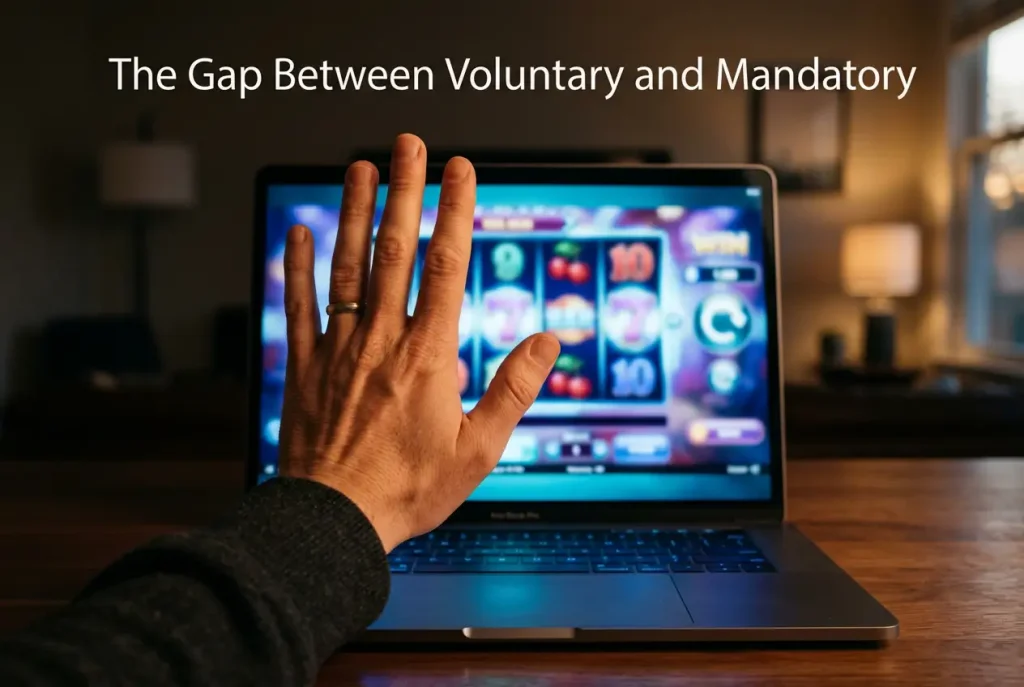
Risks
A 2026 meta-analysis published in The Lancet Public Health found that 15.8% of adults who play online slots and casino games meet the criteria for problem gambling — the highest rate among all forms of gambling studied. That number represents roughly one in six players. In a sweepstakes casino environment where responsible gaming tools are voluntary rather than mandatory, where no regulator monitors player behavior, and where the dual-currency system can obscure the real cost of play, that one-in-six figure lands differently than it would in a regulated market.
Sweepstakes casinos are not required to offer self-exclusion registries, spending limits, session timers, or any other responsible gaming mechanism. Some do anyway, because the Social Gaming Leadership Alliance encourages voluntary adoption and because public scrutiny has made basic player-protection features a reputational expectation. But the gap between voluntary and mandatory is vast — and it’s in that gap where the most vulnerable players are most exposed.
This article examines what responsible gaming tools currently exist on sweepstakes platforms, where the critical gaps are, and what academic research says about the risks facing the sweepstakes audience specifically.
What Tools Exist: The Voluntary Baseline
The largest sweepstakes platforms — those operated by VGW, Stake.us, and a handful of other major operators — have implemented some responsible gaming features. These tools vary by platform, but the most common offerings include spending limits, session timers, cooling-off periods, and self-exclusion options.
Spending limits allow players to set a maximum amount they can spend on Gold Coin purchases within a given period (daily, weekly, or monthly). When the limit is reached, the platform blocks additional purchases until the period resets. The implementation quality varies: some platforms make limits easy to set from the account dashboard; others bury the feature in settings menus that most players never visit. And notably, limits typically apply only to GC purchases, not to SC wagering — so a player who sets a $100 weekly purchase limit can still wager their existing SC balance without restriction.
Session timers display how long you’ve been playing and can trigger pop-up reminders at configurable intervals. Some platforms implement automatic session limits that log the player out after a preset duration, while others use soft reminders that can be dismissed with a single click. The effectiveness of soft reminders is questionable — behavioral research consistently shows that interruptive notifications are most effective when they require active engagement (answering a question, re-entering credentials) rather than passive dismissal.
Self-exclusion, where available, allows players to voluntarily ban themselves from the platform for a defined period or permanently. In regulated iGaming markets like New Jersey, self-exclusion feeds into a centralized state registry — if you self-exclude at one operator, you’re excluded at all of them. In sweepstakes, self-exclusion is platform-specific. Excluding yourself from Chumba Casino has zero effect on your access to LuckyLand, Stake.us, or any of the other 150+ active sweepstakes brands. This fragmentation fundamentally limits the tool’s utility for players who are genuinely struggling with compulsive behavior, because the impulse to play can be redirected to another platform within minutes.
Cooling-off periods offer a temporary break — typically 24 hours to 30 days — during which the player’s account is suspended. Unlike self-exclusion, cooling-off periods are designed to be reversible, providing a pause rather than a permanent exit. The distinction matters for players who need a circuit-breaker during a bad session but don’t want to lose permanent access to their account and any remaining SC balance.
What’s Missing: The Gap Between Voluntary and Mandatory
The tools described above represent the best case — what the most responsible operators offer voluntarily. The gaps in the system are where the real problems concentrate.
No centralized self-exclusion registry exists for sweepstakes casinos. In regulated iGaming states, a single self-exclusion enrollment covers every licensed operator in the state. A player who recognizes they have a problem can take one action and be protected across the entire market. In the sweepstakes space, with over 150 active brands operating independently, a player would need to self-exclude from each platform individually — assuming each one even offers the option. The practical barrier to comprehensive self-exclusion is insurmountable for someone in the grip of compulsive behavior.
Mandatory spending limits don’t exist. Platforms can set default limits or offer voluntary ones, but no regulation requires them. A player can spend $10,000 in a single day on Gold Coin purchases across multiple platforms without triggering any automatic intervention. In regulated markets, operators must monitor for unusual spending patterns and implement affordability checks. Sweepstakes platforms have no such obligation, and AGA data showing that 68% of players are motivated primarily by winning money — and that 80% of paying players spend monthly — underscores the scale of spending that flows through these platforms without regulatory oversight.
Age verification is inconsistent. Most sweepstakes platforms require users to be 18+, while licensed iGaming operators in most states require 21+. The three-year gap matters: research consistently shows that younger adults are more susceptible to problem gambling, and the 18–20 age group is excluded from regulated online gambling precisely because of that vulnerability. Sweepstakes platforms operating at an 18+ threshold expose a population that regulated markets have deliberately chosen to protect.
Problem gambling data isn’t collected or reported. Regulated operators must track self-exclusion enrollment, spending pattern anomalies, and customer complaints related to problem gambling. This data feeds into state-level monitoring and academic research. Sweepstakes platforms generate no comparable data, which means the scale of problem gambling within the sweepstakes population is essentially invisible. As Lia Nower, Director of the Center for Gambling Studies at Rutgers University, has argued, “We need a federal presence like we have for cigarettes, alcohol, and other forms of addiction.” That argument gains force in an industry that generates over $10 billion in annual purchases without any obligation to monitor or report the harms it may be causing.
What the Research Shows
The Lancet Public Health meta-analysis that produced the 15.8% problem gambling figure analyzed data across multiple countries and gambling formats. Online slots and casino games — the exact product category that sweepstakes casinos offer — showed the highest problem gambling prevalence of any gambling type studied. The researchers noted that the accessibility, speed, and immersive design of online slot products create conditions that are particularly conducive to compulsive behavior.
A January 2026 panel convened by Harvard University brought together addiction researchers, clinicians, and policy experts to address the rise of online gambling. Timothy Fong, co-director of UCLA’s Problem Gambling Studies Program, described the impact of pervasive online gambling as something that “has changed the fabric of our bodies and our minds.” The panel called for immediate policy action, citing the gap between the speed of digital gambling expansion and the pace of regulatory response.
What makes the sweepstakes environment specifically concerning is the dual-currency system’s potential to obscure spending. When a player buys Gold Coins and receives Sweeps Coins as a bonus, the transaction feels like purchasing a product and receiving a gift — not like placing a bet. This framing may lower psychological barriers to spending that would otherwise provide natural friction. A player who hesitates to deposit $50 at a licensed online casino might not hesitate to buy a $50 Gold Coin package, because the language of “purchase” and “bonus” is psychologically distinct from “deposit” and “wager” — even when the financial outcome is functionally identical.
The academic evidence doesn’t indict sweepstakes casinos uniquely — it indicts online slot products as a category. But sweepstakes casinos operate that high-risk product format in an environment with fewer protections, less oversight, and less data transparency than any other legal (or quasi-legal) gambling channel in the United States. The gap between voluntary and mandatory isn’t just a policy question. For the 15.8% of online slot players who develop problem gambling behaviors, it’s the difference between having a safety net and free-falling without one.
Responsible Gaming at Sweepstakes Casinos — More on this topic at sweepstakes slot machines.
See also Who Plays Sweepstakes Casinos? AGA Data on Age, Income, Gender, and….