
Gold Coins vs Sweeps Coins: How Dual Currency Works in 2026
Best Non GamStop Casino UK 2026
Loading...
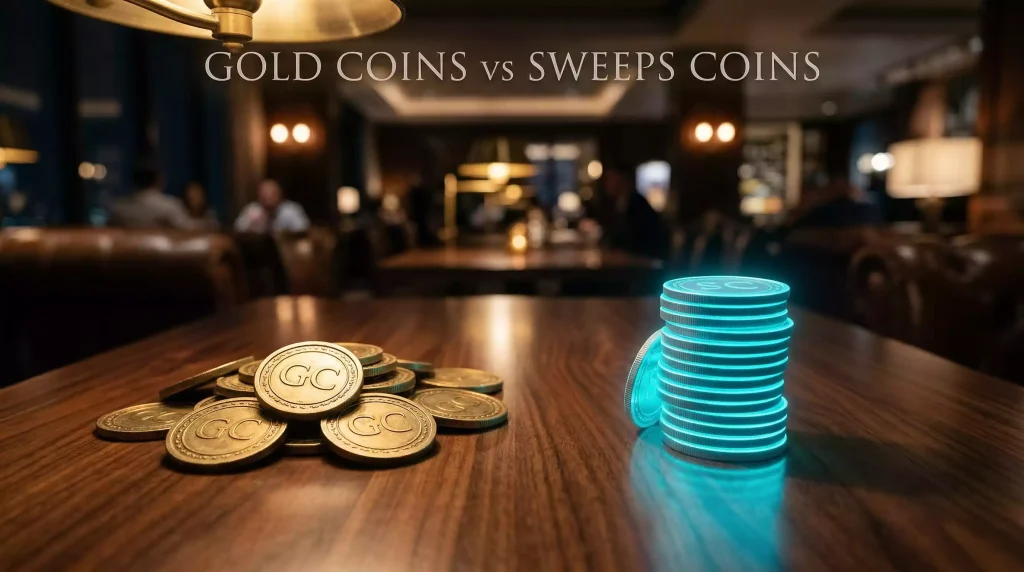
Every sweepstakes slot machine platform runs on two separate currencies, and if you don’t understand the difference between them, you’ll never cash out a dime. That’s not hyperbole — it’s how the system is designed. Gold Coins and Sweeps Coins look nearly identical inside the game lobby, sit in side-by-side balances at the top of your screen, and spin the same reels on the same slots. But one is entertainment confetti. The other is the only path to real money.
This dual-currency architecture isn’t an accident or a convenience feature. It’s the legal scaffolding that allows sweepstakes casinos to operate across most of the United States without a gambling license. The entire model hinges on the argument that players purchase Gold Coins — a virtual product — and receive Sweeps Coins as a free promotional bonus. Because you never directly buy the redeemable currency, operators claim the Prize-Chance-Consideration triangle that defines gambling under most state laws is never completed.
Whether you find that logic convincing or not, the American Gaming Association reports that 90% of sweepstakes casino players consider their activity to be gambling. The legal distinction may hold up in court — at least for now — but the player experience tells a different story. Understanding exactly how Gold Coins and Sweeps Coins function isn’t just useful trivia. It determines what you can win, what you can withdraw, and what happens to your balance if your state decides to ban the whole thing tomorrow.
Gold Coins: The Play-Only Currency
Gold Coins are the currency you actually buy. They come in packages — typically ranging from a few dollars to $100 or more — and the pricing structure is deliberately familiar to anyone who’s purchased in-game currency on a mobile app. A $10 package might include 20,000 GC; a $50 package might offer 150,000 GC with a “bonus” multiplier. The exact ratios vary by platform, but the pattern is consistent: spend more, get a better per-coin rate.
What Gold Coins cannot do is convert to cash. There is no redemption pathway. You cannot withdraw them, exchange them for Sweeps Coins at any ratio, or transfer them to another player. Once you buy Gold Coins, they exist solely within the platform as play tokens. You use them to spin slots, play table games, or sit in on poker rooms, and when they’re gone, they’re gone. If you win more GC through gameplay, congratulations — you have more play tokens.
This feels counterintuitive. Why would anyone pay real money for a virtual currency that has no cash value? The answer lies in what comes bundled with the purchase. Every Gold Coin package includes a free allocation of Sweeps Coins as a promotional bonus. The GC purchase is the vessel; the SC bonus is the payload. Platforms are careful to frame this as a purchase of entertainment value (Gold Coins) with a complimentary promotional item (Sweeps Coins) — not a purchase of redeemable currency. The legal distinction matters enormously, even if the practical experience feels like buying chips at a casino.
Gold Coins also arrive through daily login bonuses, social media promotions, and occasional in-game rewards. These free GC allocations keep the lobby active and give players who haven’t purchased anything a reason to return. But the core function remains unchanged: GC is the currency that keeps the lights on aesthetically, while doing nothing for your bank account.
Sweeps Coins: The Currency That Matters
Sweeps Coins are the redeemable currency — the one that turns virtual wins into actual dollars in your bank account. On most platforms, the conversion rate is straightforward: 1 SC equals $1 in prize value. You accumulate SC through gameplay (winning spins, hitting bonus rounds, completing wagering requirements), and once your balance crosses the platform’s minimum threshold — usually somewhere between 50 SC and 100 SC — you can submit a redemption request.
The sources of Sweeps Coins are where the legal architecture becomes visible. You can receive SC in three ways. The first and most common is as a bonus attached to a Gold Coin purchase. Buy a $20 GC package and you might receive 20 SC free. The second is through daily login bonuses and promotional events — platforms regularly distribute small amounts of SC (1–5 SC per login, typically) to keep engagement high. The third is through AMOE — Alternative Method of Entry — which is the mechanism that holds the entire sweepstakes legal framework together.
AMOE entries allow players to receive Sweeps Coins without making any purchase. The most traditional form is a mail-in request: send a physical letter to the operator’s address, and they’re legally required to credit SC to your account. Some platforms also offer online AMOE forms, social media giveaways, or referral programs that distribute SC without requiring payment. The existence of this free entry method is what separates sweepstakes casinos from gambling operations under most interpretations of U.S. law. If players can participate without paying, the “consideration” element of gambling is theoretically absent.
In practice, the AMOE pathway is used by a sliver of the player base. According to research from the Responsible Gambling Council, only about 12% of sweepstakes casino users ever make a purchase — the rest play exclusively on free coins. But that 12% drives the entire revenue model. Among paying users, spending is frequent: AGA data shows that 80% of paying players spend money monthly and roughly half spend weekly. The whale-driven economics of sweepstakes casinos mirror mobile gaming’s freemium model, where a small cohort of high-spending users subsidizes the majority who play for free.
Redemption itself isn’t instant. Once you request a withdrawal, you’ll typically face a KYC (Know Your Customer) verification process that requires government-issued ID, proof of address, and sometimes your Social Security number. Processing times range from 1 to 14 business days depending on the platform and payment method. Bank transfers and PayPal tend to process faster than check payouts. And here’s a detail that catches many players off guard: your SC winnings are taxable income under IRS rules, regardless of whether the platform issues a 1099 form.
GC vs SC: Direct Comparison
Strip away the marketing language, and the difference between Gold Coins and Sweeps Coins reduces to one question: can you turn it into money? Everything else — how you earn them, how you spend them, what they look like inside the game — flows from that single distinction.
| Feature | Gold Coins (GC) | Sweeps Coins (SC) |
|---|---|---|
| Primary source | Direct purchase | Free bonus with GC purchase, AMOE, promotions |
| Cost to acquire | $1–$100+ per package | $0 (bundled free or earned) |
| Redeemable for cash | No | Yes (typically 1 SC = $1) |
| Legal classification | Virtual entertainment currency | Promotional sweepstakes entry |
| Gameplay function | Spins slots, plays games | Spins slots, plays games |
| Minimum redemption | N/A | 50–100 SC (varies by platform) |
| Taxable | No (no cash value) | Yes (IRS treats as income) |
| Available via free entry | Yes (login bonuses, promos) | Yes (AMOE, login bonuses, promos) |
The table makes the distinction clean, but the player experience muddies it considerably. Inside the game lobby, you toggle between GC mode and SC mode with a single click. The same slot — say, a Hacksaw Gaming title like Wanted Dead or a Wild — plays identically in both modes. The reels look the same. The bonus rounds trigger the same way. The only difference is whether your wins accumulate in a redeemable balance or a decorative one. This seamless overlap is intentional. It creates a frictionless path from free play (GC) to real-money engagement (SC) — and it’s why the legal distinction between “sweepstakes” and “gambling” feels academic to most people sitting in front of the screen.
For players, the practical takeaway is straightforward: Gold Coins are the price of admission, and Sweeps Coins are the reason you showed up. Every decision — which package to buy, which bonus to claim, which AMOE method to pursue — should be evaluated through the lens of SC yield. A $50 GC package that includes 35 SC is a worse deal than a $30 package that includes 30 SC, no matter how many Gold Coins come with it. The currency that matters is the one that converts to cash, and everything else is set dressing.
That said, the dual-currency system exists in an increasingly hostile regulatory environment. Six states banned sweepstakes casinos outright in 2026 — Montana, Connecticut, New Jersey, Nevada, California, and New York — and analysts at Eilers & Krejcik Gaming project a 10% revenue decline for the industry in 2026. If your state joins the ban list, both your GC and SC balances become stranded assets. Platforms have handled transitions differently — some offer grace periods for redemption, others have simply shut off access. Understanding which currency holds value and how quickly you can redeem it isn’t just smart financial planning. In this market, it’s risk management.