
Louisiana vs VGW and WOW Vegas: How a $44 Million Tax Lawsuit Could Redefine Sweepstakes Casino Economics
 Available in GB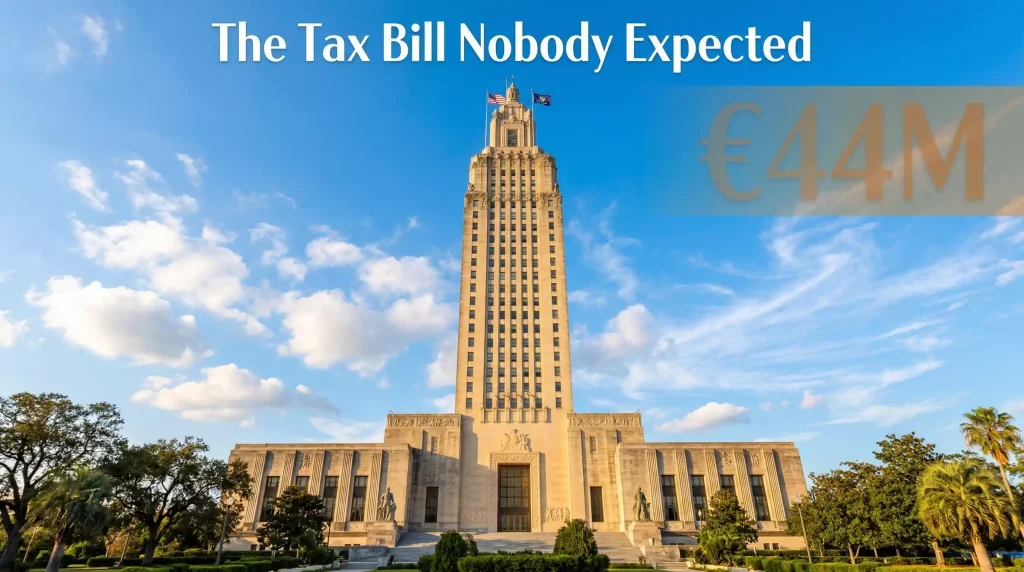
In September 2026, the Louisiana Department of Revenue filed what may become the most consequential legal action in sweepstakes casino history. The state sued VGW for $32.5 million and WOW Vegas (operated by A1 Development) for $13.6 million — a combined $44 million in alleged unpaid sales tax on virtual currency sales. It was the first time any U.S. state had attempted to collect sales tax from sweepstakes casino operators, and the implications extend far beyond Louisiana’s borders.
The case cuts directly at the business model’s most vulnerable seam. Sweepstakes operators have spent years arguing that Gold Coin purchases are legitimate retail transactions — not gambling wagers — to defend against gambling charges. Louisiana turned that argument into a tax obligation: if GC purchases are retail sales, they’re subject to state sales tax. The industry’s own legal defense became the basis for a tax claim worth tens of millions of dollars. The tax bill nobody expected arrived precisely because the industry had worked so hard to be classified as something other than gambling.
The Case: What Louisiana Argued and What It’s Worth
Louisiana’s legal argument is built on a straightforward application of the state’s sales tax code to digital transactions. When a Louisiana resident purchases a $50 Gold Coin package on a sweepstakes platform, the state contends that this transaction constitutes a retail sale of a digital product — subject to the same sales tax that applies to buying software, streaming subscriptions, or any other digital good. Louisiana’s combined state and local sales tax rates average approximately 9.5%, among the highest in the nation.
The $32.5 million claim against VGW covers multiple years of Gold Coin sales to Louisiana residents. The calculation is conceptually simple: total GC purchases by Louisiana players multiplied by the applicable sales tax rate, plus penalties and interest for non-payment. For a state with Louisiana’s sales tax rate, even modest sweepstakes purchase volumes generate significant tax obligations over time. VGW, as the market leader with approximately 35–40% of U.S. sweepstakes revenue, had the largest Louisiana exposure of any operator.
The $13.6 million claim against WOW Vegas (A1 Development) follows the same logic applied to a smaller operator’s transaction volume. Together, the two defendants represent the largest and one of the mid-tier operators in the space — a deliberate choice that signals the state’s intent to establish the principle broadly rather than target a single outlier.
What makes the Louisiana argument particularly difficult for operators to contest is the industry’s own positioning. In gambling lawsuits and regulatory disputes, sweepstakes operators consistently argue that players “purchase Gold Coins” — a legitimate consumer product — and receive Sweeps Coins as a free promotional bonus. This framing is the legal shield against gambling classification. But it simultaneously establishes that GC purchases are commercial transactions involving the exchange of money for a product. Louisiana’s Department of Revenue didn’t need to prove that sweepstakes casinos are gambling to assess sales tax. It only needed to prove that GC purchases are sales — which is exactly what the operators themselves have been arguing.
The logical trap is elegant: the industry can’t simultaneously argue that GC purchases are product sales (to avoid gambling charges) and that GC purchases are not product sales (to avoid sales tax). Whichever legal position the operators choose to defend, the other position becomes available to the opposing party. Louisiana chose the one that generates revenue for the state rather than criminal liability for the operator — a pragmatic approach that may prove more sustainable than outright prohibition.
Why This Case Changes Everything
The precedential value of the Louisiana suit extends well beyond one state’s tax claim. If Gold Coin purchases are taxable sales in Louisiana, the same logic applies in every state with a sales tax — which is 45 states plus the District of Columbia. The five states without sales tax (Alaska, Delaware, Montana, New Hampshire, and Oregon) are the only jurisdictions where the argument doesn’t apply, and Montana has already banned sweepstakes casinos outright.
VGW’s response to the Louisiana case revealed the company’s strategic calculus. Rather than contest the principle that GC purchases are taxable, VGW began voluntarily collecting sales tax on Gold Coin purchases across multiple states — not just Louisiana. This preemptive compliance suggests that VGW’s legal team concluded the tax classification is defensible on the state’s side and that fighting it jurisdiction by jurisdiction would be more expensive and damaging than absorbing the cost.
The financial impact on operator margins is significant. A 6–10% sales tax on GC purchases comes directly off the top line. If a player pays $100 for a Gold Coin package, the operator now remits $6–$10 to the state before accounting for prize payouts, content licensing fees, payment processing, and operating costs. For an industry where net revenue (after prize payouts) represents roughly 30% of gross purchases, adding a 6–10% tax on the gross figure compresses margins by approximately 20–33%. Smaller operators with thinner margins may find that the post-tax economics no longer support continued operation in high-tax states.
VGW’s FY2024 revenue of approximately $4 billion provides a scale reference. If sales tax were applied retroactively across all states where VGW operates, the potential liability would run into hundreds of millions of dollars. The Louisiana suit’s $32.5 million represents a single state’s claim — the total across all states could be an order of magnitude larger. Whether other states pursue similar claims depends on whether Louisiana’s case succeeds and how visible the potential revenue becomes to other state revenue departments.
Which States Come Next
The largest sweepstakes markets are also states with substantial sales tax infrastructure and revenue incentives to pursue collection. Texas, with $1.41 billion in sweepstakes purchases and a 6.25% state sales tax (plus local rates that can push the combined rate above 8%), represents over $100 million in potential annual tax revenue. Florida, at $1.12 billion in purchases and a 6% base sales tax, represents another $67 million or more. These aren’t speculative numbers — they’re arithmetic applied to published market data.
Shawn Fluharty, President of NCLGS, framed the issue in terms that every state legislator understands: sweepstakes operations represent “illegal gambling and revenue theft in many states.” The “revenue theft” language is deliberate — it positions sweepstakes operators not as businesses exercising legal rights but as entities taking money that belongs to the state. That framing from the NCLGS, which represents gaming legislators from all 50 states, creates a political environment where pursuing tax collection is both fiscally attractive and politically easy.
The cascade scenario is plausible: Louisiana establishes the principle, VGW’s voluntary compliance validates it, and other states follow with their own demands. Each state that successfully collects sales tax from sweepstakes operators creates additional precedent that makes the next state’s case stronger. For operators, the compounding tax burden across 40+ states may fundamentally alter the economics of the sweepstakes model — not through bans, but through taxation that makes the margins unsustainable for all but the largest, most efficient operators.
For the industry, the Louisiana case represents a third regulatory front. Bans eliminate markets. Enforcement actions disrupt operations. Tax claims erode profitability. Together, the three vectors create a compression that no sweepstakes operator can ignore — and the tax bill nobody expected may ultimately prove more transformative than the bans that dominate the headlines.
Louisiana vs VGW and WOW Vegas — More on this topic at sweepstakes slot machines.
See also Whale Economics in Sweepstakes Casinos.