
Sweepstakes Casino Advertising in the US: How Unregulated Platforms Captured Half the Market’s Ad Spend
 Available in GB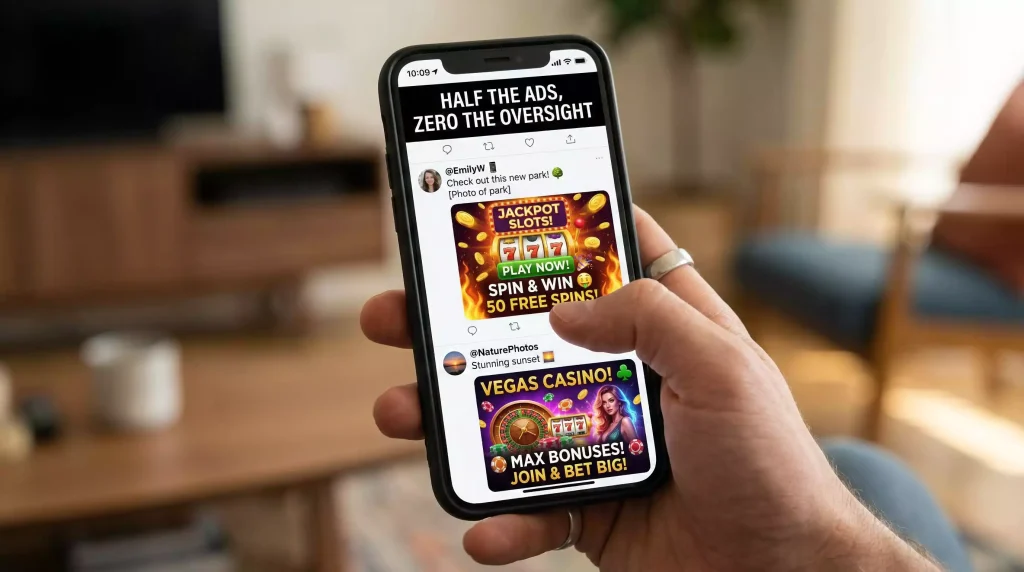
In early 2026, roughly half of all online casino advertising in the United States came from sweepstakes platforms — operators that hold no gambling licenses, submit to no advertising standards boards, and face none of the marketing restrictions that apply to regulated iGaming operators in states like New Jersey, Michigan, and Pennsylvania. That 50% ad share, documented through AGA and Sensor Tower data, represents one of the most striking asymmetries in the American gambling landscape: the platforms with the least regulatory oversight command the most advertising visibility.
The advertising dominance didn’t happen by accident. It’s the product of a structural advantage — sweepstakes casinos face no advertising restrictions because they’re not classified as gambling operators — combined with aggressive customer acquisition strategies funded by an industry growing at 60–70% annually. Understanding how sweepstakes advertising works, why it faces less scrutiny than regulated gambling ads, and what the regulatory response looks like tells you as much about the industry’s trajectory as any market data or legal analysis.
50% of the Ad Market: How Sweepstakes Platforms Dominate
The AGA/Sensor Tower data captures advertising volume across digital channels — social media platforms, programmatic display networks, YouTube, podcast sponsorships, and influencer partnerships. Sweepstakes casinos’ 50% share of U.S. online casino advertising means that for every ad a player sees from DraftKings Casino or BetMGM, they see an approximately equal volume of advertising from unlicensed sweepstakes platforms.
The advertising channels skew heavily toward social media. Facebook, Instagram, and TikTok host aggressive sweepstakes casino campaigns featuring eye-catching creative — spinning reels, flashing jackpot numbers, and “free to play” messaging prominently displayed. YouTube pre-roll ads and mid-roll sponsorships on gambling-adjacent content (sports, entertainment, gaming) are common. Podcast sponsorships, particularly on shows targeting younger demographics (18–40), have emerged as a growth channel. Influencer marketing — where social media personalities promote sweepstakes platforms to their audiences, often with referral codes that earn commissions — rounds out the mix.
The messaging strategy centers on two themes that work in tension. The first is “free to play” — emphasizing that sign-ups cost nothing, free Sweeps Coins are available without purchase, and the sweepstakes model is fundamentally different from gambling. The second is “win real cash” — highlighting the redemption pathway, showcasing big winners, and displaying jackpot amounts in dollar-equivalent terms. The juxtaposition of “free” and “real money” is the core of sweepstakes advertising, and it exploits a genuine feature of the product (free entry does exist) while de-emphasizing the reality that most players spend money (80% of paying users spend monthly).
Why can sweepstakes platforms advertise more aggressively than regulated casinos? In regulated iGaming states, advertising is subject to gaming commission oversight. State regulators can restrict ad content, mandate responsible gaming disclosures, prohibit targeting of minors or vulnerable populations, and penalize operators whose advertising is deemed misleading. Sweepstakes casinos, operating outside the gaming regulatory framework, face none of these constraints. Their advertising is governed only by general FTC guidelines on deceptive marketing and the content policies of individual advertising platforms — standards that are far less restrictive than gaming-specific advertising regulations.
Regulatory Pushback: AGA, State AGs, and the FTC
The advertising asymmetry has drawn sharp criticism from the regulated gambling industry. AGA Vice President Tres York articulated the industry’s position directly, stating that sweepstakes operators “present themselves like legal, regulated platforms — but they operate outside the law and regulation. There are few if any responsible gaming tools, no regulatory oversight and no consumer protections. It’s a dangerous subterfuge that puts players at real risk.” The AGA has lobbied for advertising restrictions on sweepstakes platforms, arguing that the 50% ad share creates a misleading competitive landscape where unlicensed operators outshout licensed ones.
State attorney general actions have had a measurable impact on advertising volume. When New York’s AG issued 26 cease-and-desist orders, the affected platforms immediately pulled their advertising from New York-targeted channels. California’s ban eliminated one of the largest advertising markets in the country. Each state ban or enforcement action removes an advertising segment, and the cumulative effect of six bans and 100+ C&D orders has begun to narrow the geographic footprint available for sweepstakes advertising campaigns.
The FTC has not taken specific action against sweepstakes casino advertising as of early 2026, but the Commission’s general guidelines on deceptive advertising apply. If sweepstakes ads create a misleading impression — for example, by emphasizing “free play” while omitting that most players spend money, or by displaying jackpot amounts without disclosing that redemption requires KYC verification and carries tax obligations — the FTC could theoretically pursue enforcement under Section 5 of the FTC Act. Whether the Commission prioritizes sweepstakes advertising among its enforcement caseload depends on political priorities, resource allocation, and the volume of consumer complaints reaching the Commission.
Social media platforms themselves have begun tightening policies. Meta (Facebook/Instagram) has updated its gambling advertising policies multiple times, and some sweepstakes operators report increased difficulty getting ads approved. Google restricts gambling-related advertising to licensed operators in regulated jurisdictions, which means sweepstakes platforms must navigate content classification carefully to avoid having their ads flagged and removed. These platform-level restrictions create operational friction but haven’t significantly reduced sweepstakes advertising volume — operators adapt by adjusting creative, rotating accounts, and shifting spend to less restricted channels.
How Advertising Shapes Player Expectations
The gap between sweepstakes advertising messaging and player reality is where the most tangible harm concentrates. “Free to play” messaging attracts players who genuinely believe they can participate without financial cost — and they can, initially. But the advertising doesn’t emphasize that AMOE entry is deliberately inconvenient, that free SC amounts are too small to reach redemption thresholds without additional play or purchases, or that the platform’s entire business model depends on converting free users into paying ones.
“Win real cash” messaging attracts players motivated by financial outcomes — and AGA data confirms that 68% of sweepstakes players cite winning money as their primary motivation. But advertising rarely contextualizes what “winning” looks like mathematically. The house edge ensures that the average player loses money over time. The 12% purchase conversion rate means that the revenue model concentrates on a small minority of players who spend disproportionately. And the demographic data — 42% of players earning under $50,000 — suggests that the advertising is most effective among populations least equipped to absorb gambling losses.
For players navigating this landscape, the most practical defense is informational. Advertising exists to acquire customers, not to educate them. Every claim in a sweepstakes ad should be verified against the platform’s actual terms of service, bonus conditions, RTP disclosures (where available), and redemption process. Half the ads, zero the oversight is the advertising reality of U.S. sweepstakes casinos in 2026 — and the only party with both the incentive and the ability to close the information gap between advertising promises and player experience is the player themselves. Every “free to play” banner should prompt the question: free for how long, and free for whom? The answer, for most players who engage with the product beyond the sign-up bonus, is neither indefinitely nor for them.
Sweepstakes Casino Advertising in the US — More on this topic at sweepstakes slot machines.
See also Sweepstakes Casino KYC.