
Sweepstakes Casino Legal States in 2026: Full State-by-State Access Map
 Available in GB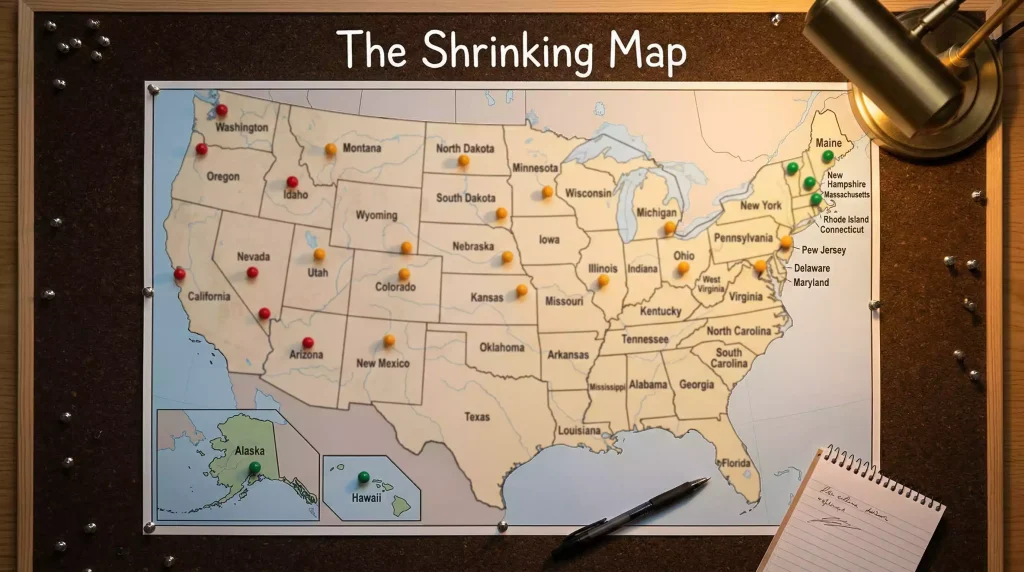
Can’t Play (2026)
The sweepstakes casino legal states map shrank significantly in 2026. Six states passed outright bans, dozens of regulatory enforcement actions pushed operators out of additional markets, and the once-simple answer to “where can I play?” became a patchwork of full bans, partial restrictions, and quiet permissiveness that varies from state to state.
Understanding the current map matters for practical reasons. If you sign up on a sweepstakes platform from a banned state, you won’t be able to complete KYC verification or redeem SC — meaning any time and money you invest is effectively stranded. If you’re in a state with active enforcement but no formal ban, the legal ground may shift under you mid-session. And if you’re in one of the large open markets, the precedent from banned states suggests that the current access window may be temporary. This guide provides a snapshot of the legal landscape as of early 2026 — but given the pace of regulatory change, checking your specific state’s status before playing is essential.
Six States With Outright Bans
As of January 2026, six states have enacted legislation specifically prohibiting sweepstakes casinos. These bans vary in their effective dates, penalty structures, and enforcement mechanisms, but the result is the same: sweepstakes platforms cannot legally sell Gold Coins to residents of these states, and players cannot redeem Sweeps Coins.
Montana was the first state to act. SB 555, signed in May 2026 and effective October 1, 2026, established the template that subsequent states would follow. Montana’s sweepstakes market was relatively small compared to what came next, but the bill’s passage broke the legislative ice and demonstrated that bans could move from introduction to signature quickly.
Connecticut followed with SB 1235, which targeted both sweepstakes casinos and related promotional gaming platforms. The bill was driven partly by the state’s existing relationships with Mohegan Sun and Foxwoods — tribal gaming interests that viewed sweepstakes operators as unlicensed competitors.
New Jersey passed A5447, a natural extension of the state’s aggressive stance on gambling regulation. As home to Atlantic City and one of the most mature legal iGaming markets in the country, New Jersey had strong institutional incentives to protect its licensed operators from unregulated competition.
Nevada’s SB 256 was perhaps the most symbolically significant. The gambling capital of the world — where the entire regulatory infrastructure exists to oversee licensed gaming — was not going to tolerate unlicensed operations on its doorstep. The Nevada ban carried particular weight with industry observers because it signaled that even gambling-friendly jurisdictions drew the line at sweepstakes casinos.
California’s AB 831, effective January 1, 2026, was the most economically impactful. California’s $2.42 billion sweepstakes market represented 17.3% of the U.S. total. The bill passed with zero opposing votes in either chamber, backed by a coalition of tribal gaming operators, commercial cardrooms, and consumer protection advocates.
New York’s SB 5935A, signed in December 2026, followed Attorney General Letitia James’s 26 cease-and-desist orders that had already forced all major operators out of the state. The legislation formalized what enforcement had already accomplished, converting a discretionary AG action into permanent statutory prohibition.
The six bans collectively removed billions in addressable market. California and New York alone represented approximately $3.2 billion in annual sweepstakes purchases — with California at $2.42 billion and New York at $762 million. The political coalition behind each ban was remarkably similar: tribal gaming interests defending their licensed operations, regulated iGaming operators seeking protection from unlicensed competitors, and consumer protection advocates concerned about the absence of responsible gaming standards. That coalition formula proved repeatable across jurisdictions — a pattern that makes additional bans in 2026 a matter of political timing rather than political feasibility.
States With Active Enforcement but No Formal Ban
Beyond the six outright bans, a second tier of states has taken enforcement action without passing dedicated legislation. According to iGaming Business reporting, state regulators issued more than 100 cease-and-desist orders to sweepstakes operators across at least seven states in 2026: Arizona, Michigan, Louisiana, Maryland, Mississippi, Pennsylvania, and Illinois.
The distinction between a ban and enforcement-driven restriction matters operationally. In banned states, the prohibition is statutory — it requires new legislation to reverse. In enforcement-driven states, the restrictions flow from regulatory interpretation of existing gambling laws, which means they could theoretically be challenged in court, reversed by a new AG, or undermined by a favorable legal ruling. For players, though, the practical effect is similar: operators that receive C&D orders typically comply rather than litigate, which means access disappears regardless of the legal mechanism that caused it.
Idaho and Washington represent a separate category — states that have been effectively closed to sweepstakes casinos for years due to broad anti-gambling statutes that predate the sweepstakes boom. These states didn’t need new legislation; their existing laws were already interpreted to prohibit the sweepstakes model. Most legitimate platforms have geo-blocked these states since their inception.
The enforcement tier is the most volatile category on the map. States currently issuing C&D orders may escalate to full bans (as New York demonstrated), or they may reach a regulatory equilibrium where major operators comply with individual orders while the market continues in a reduced form. Players in enforcement-active states should monitor their state AG’s public statements and be prepared for access changes that can occur without the legislative timeline that formal bans require.
Where Sweepstakes Casinos Still Operate Freely
The majority of U.S. states — roughly 35 to 40, depending on how you classify enforcement-active jurisdictions — have no specific legislation or active enforcement targeting sweepstakes casinos. In these states, platforms operate in the legal gray zone that has defined the industry since its inception: no explicit permission, no explicit prohibition, and no regulatory framework governing their operations.
The largest open markets are Texas and Florida. Texas generated $1.41 billion in sweepstakes purchases in 2026 (+112% year-over-year), while Florida produced $1.12 billion (+78%). Together, these two states represent over $2.5 billion in annual sweepstakes revenue — a concentration that makes them simultaneously the industry’s most valuable assets and its highest-risk regulatory targets.
AGA research shows that sweepstakes casino player participation roughly doubles in states without explicit bans compared to states that have acted. This multiplier effect means that the open states collectively carry the industry’s revenue weight — and that each additional ban disproportionately impacts the remaining addressable market. If Texas or Florida were to follow California’s trajectory, the industry’s revenue base would contract by another $2.5 billion overnight.
For players in open states, the current access represents an uncertain window. The regulatory trend is clearly toward restriction — six bans in a single year, 100+ C&D orders, and analyst projections of a 10% revenue decline in 2026. Playing in an open state today doesn’t guarantee playing tomorrow, and treating your SC balance as a potentially time-limited asset (by maintaining redeemable balances and completing KYC proactively) is the practical response to a shrinking map. The states that are open now weren’t targeted in the first wave of bans — but the second wave, if it comes, will draw from exactly this pool of remaining markets.