
Sweepstakes vs Social Casinos: Why One Generates $10.6B and the Other Is Stagnating
 Available in GB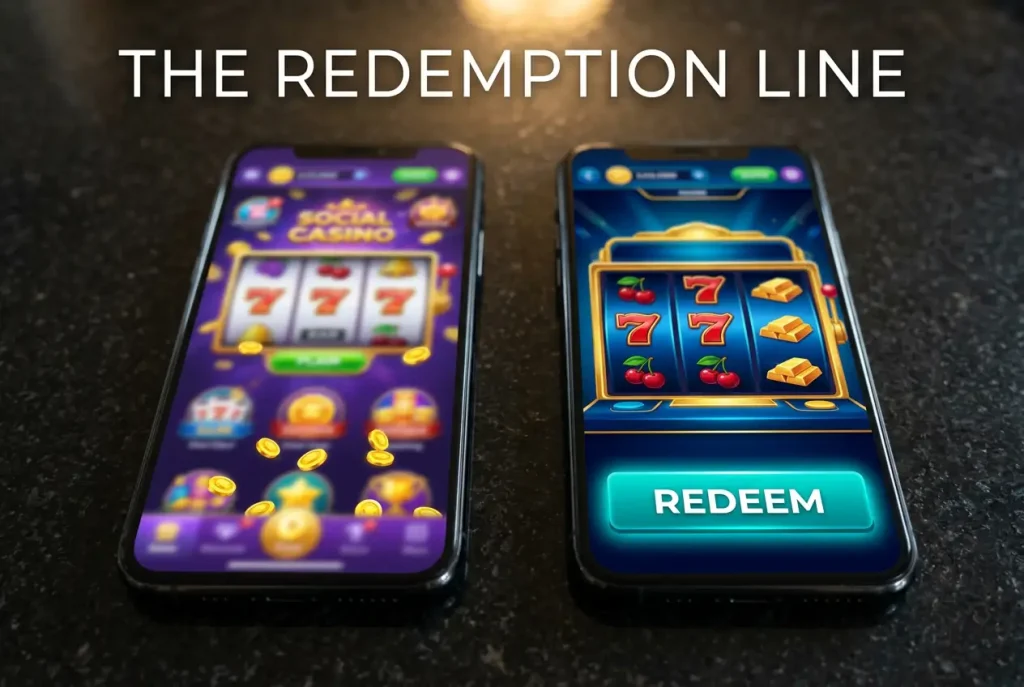
Two categories of online casino products dominate the U.S. market outside regulated iGaming, and from the outside they look nearly identical. Both offer slot-style games. Both sell virtual currency. Both operate in most states without gambling licenses. But one generated $10.6 billion in gross revenue in 2026 while the other produced $7.1 billion and is heading toward stagnation. The difference between sweepstakes casinos and social casinos is a single word: redemption.
Sweepstakes casinos offer a path from virtual currency to real cash through Sweeps Coin redemption. Social casinos do not — their virtual currency has no cash value under any circumstances. That one distinction shapes everything: the regulatory response, the player demographics, the spending behavior, the legal exposure, and the revenue trajectory of each category. Understanding the difference isn’t academic. If you’re choosing where to play, or trying to understand why six states banned one category and not the other, the redemption line is where the answer begins.
How the Models Differ: Redemption Changes Everything
Social casinos operate on a straightforward virtual-currency model. You download an app or visit a website, receive free virtual coins, and play slot-style games. When your coins run out, you can buy more through in-app purchases or wait for daily refills. Your virtual balance goes up and down as you play, but it never converts to money. There’s no KYC, no redemption process, and no tax obligation, because nothing you win has monetary value. The product is entertainment, pure and simple — the same economic model as buying lives in Candy Crush or gems in Clash of Clans.
Sweepstakes casinos layer the dual-currency system on top of this foundation. Gold Coins function identically to social casino virtual currency — purchased directly, used for play, and non-redeemable. Sweeps Coins, received as promotional bonuses alongside GC purchases or through free AMOE entry, add the redemption pathway. Play SC, accumulate winnings, complete KYC verification, and convert your SC balance to real cash at a typical rate of 1 SC = $1.
| Feature | Social Casino | Sweepstakes Casino |
|---|---|---|
| Virtual currency | Yes (play-only) | Yes (GC play-only + SC redeemable) |
| Cash redemption | No | Yes (SC → cash) |
| KYC required | No | Yes (for SC redemption) |
| Tax obligations | None | Yes (IRS treats SC winnings as income) |
| Gambling classification | Not considered gambling | Disputed — 90% of players say yes |
| Regulatory pressure | Minimal | Six state bans, 100+ lawsuits |
| App Store availability | Yes (native apps) | Mostly PWA only |
The legal classification follows from the redemption distinction. Social casinos have been largely uncontested legally because they lack the “prize” element — you can’t win anything of monetary value, so the gambling framework doesn’t apply. Sweepstakes casinos claim the same legal space by arguing that SC redemption is a promotional prize rather than a gambling payout, but regulators and courts in multiple states have rejected that argument. The six state bans passed in 2026 targeted sweepstakes casinos specifically. No state has banned social casinos.
$10.6B vs $7.1B: Why Revenue Trajectories Diverged
According to KPMG data based on Eilers & Krejcik Gaming research, the global social casino market generated $7.1 billion in gross revenue in 2026. Analysts project stagnation through 2027, with flat-to-modest growth as the category matures and competition from sweepstakes platforms intensifies. Sweepstakes casinos, by contrast, hit $10.6 billion in 2026 after growing at a compound annual rate of 60–70% between 2020 and 2026.
The revenue gap reflects a fundamental behavioral difference: the redemption pathway changes spending motivation. In social casinos, players buy virtual currency for entertainment value — the same way they’d buy a movie ticket or a video game. The spending ceiling is bounded by what a player is willing to pay for entertainment that produces no financial return. In sweepstakes casinos, players buy Gold Coins knowing that the attached Sweeps Coins can convert to real cash. The spending motivation shifts from “paying for fun” to “investing in a chance to win money,” and the ceiling rises accordingly.
The data confirms this shift. AGA research shows that 68% of sweepstakes players cite winning real money as their primary motivation — a sentiment that doesn’t apply to social casino users, who know from the outset that their virtual currency has no cash value. The spending frequency reflects this: 80% of paying sweepstakes users spend monthly, and half spend weekly. These engagement levels exceed what social casinos typically see from their paying user base.
But the same feature driving sweepstakes revenue growth is now driving its contraction. The redemption pathway is what regulators object to. It’s what makes sweepstakes casinos look like gambling to 90% of their own users. And it’s why six states banned sweepstakes casinos while social casinos continue operating without controversy. The revenue story is inseparable from the regulatory story: sweepstakes outgrew social casinos because they offered something social casinos don’t, and now they face regulatory pressure for exactly that reason.
The revenue divergence also reflects platform dynamics. Social casinos are primarily distributed through Apple’s App Store and Google Play — where they have native apps, benefit from app store discovery, and can process in-app purchases seamlessly. Sweepstakes casinos, locked out of app stores by platform policies, rely on web-based PWAs and direct marketing. Despite this distribution disadvantage, sweepstakes revenue surpassed social casino revenue by over $3 billion. The redemption pathway doesn’t just change player motivation — it changes how much players are willing to spend and how often they’re willing to spend it, even when the platform delivering the experience is technically inferior in accessibility terms.
What the Difference Means for Players
If you’re choosing between a social casino and a sweepstakes casino, the decision hinges on what you want from the experience. Social casinos offer pure entertainment with zero financial risk beyond the purchase price of virtual coins. You will never win money, but you will also never lose money beyond what you spend on coins, never need to provide your Social Security number, and never face a surprise tax bill. The product is exactly what it appears to be.
Sweepstakes casinos offer a fundamentally different value proposition: the possibility of converting virtual wins into real cash. That possibility changes the emotional and financial stakes of every session. When SC has real-dollar value, a losing streak isn’t just depleting entertainment tokens — it’s eroding a balance that could have been withdrawn as cash. The psychological weight of redeemable currency explains why sweepstakes players spend more, play more frequently, and describe their experience as gambling at a 90% rate.
The redemption line also introduces complexity that social casinos don’t have. Sweepstakes players must navigate KYC verification, understand tax obligations, monitor their state’s legal status, and manage the risk that access could be revoked if their state passes a ban. None of these concerns apply to social casino users. Whether the potential financial upside of sweepstakes justifies the additional complexity, risk, and emotional weight is a personal judgment — but it should be an informed one, made with a clear understanding of what each model offers and what it demands in return. The $10.6 billion flowing through sweepstakes versus the $7.1 billion flowing through social casinos tells you which model most players have chosen. The six state bans and 100+ lawsuits tell you what regulators think about that choice.
Sweepstakes vs Social Casinos — More on this topic at sweepstakes slot machines.
See also Classic vs Video Sweepstakes Slots.